Ayahuasca Medication Interactions: A Drug-By-Drug Timeline

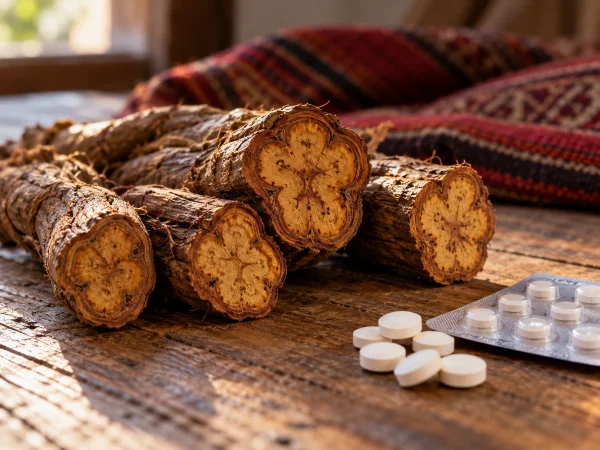
Ayahuasca medication interactions start in the vine. Its harmine and harmaline block MAO-A, the enzyme that breaks down serotonin, norepinephrine and dopamine. Mix that with an SSRI, an SNRI, lithium, tramadol, a stimulant or a decongestant, and you risk serotonin syndrome, a blood pressure spike or a seizure.
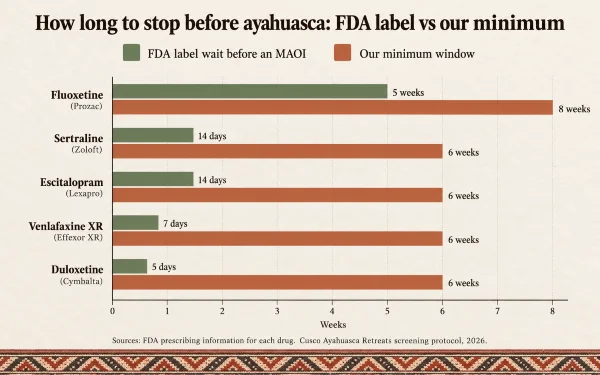
The fix is time, and the clock starts after your taper, not before it. The FDA label for Prozac says to wait at least 5 weeks after the last dose before starting an MAOI. Our physician asks for 8. For other SSRIs and SNRIs, we ask for at least 6 weeks off, counted from the end of your taper. Lithium and prescription MAOIs are an automatic no.
Before I co-founded Cusco Ayahuasca Retreats, I spent 6 years at a New York firm defending drug makers in opioid and antidepressant lawsuits. I know how much weight a drug label carries, so this guide is built on the labels themselves.
What are ayahuasca medication interactions?
Ayahuasca medication interactions are reactions between a drug and the alkaloids in the ayahuasca vine. Harmine and harmaline block MAO-A, the enzyme that clears serotonin and norepinephrine. Drugs that raise serotonin can then trigger serotonin syndrome. Drugs that raise norepinephrine can spike blood pressure. DMT, the brew’s other active compound, also acts on serotonin receptors.
Lab work on these alkaloids found them reversible and selective for MAO-A (Kim and colleagues, 1997). Reversible means the block wears off as the alkaloids clear. That detail matters later, for food and for restarting your medication.
Why psilocybin advice doesn’t carry over
Maybe a friend did a psilocybin retreat while on an SSRI and felt fine. That tells you nothing about ayahuasca.
A 2022 paper in Psychopharmacology by Ben Malcolm and Kelan Thomas looked at serotonin toxicity with psychedelics. True serotonin toxicity, they wrote, typically needs a serotonin-raising drug combined with an MAOI. Serotonergic drugs without an MAOI were low risk with psychedelics that don’t contain one. Ayahuasca is the psychedelic that does. That single fact is why ayahuasca differs from other psychedelics when you’re on medication.
How thin the evidence is
A 2024 systematic review in the Journal of Psychopharmacology searched the published research on drug interactions with classic psychedelics. It found 52 studies. Only 1 involved ayahuasca.
That 1 was a 1998 case report by James Callaway and Charles Grob. A 36-year-old man taking 20 mg of fluoxetine a day drank about 100 ml of ayahuasca. An hour later he had tremors, sweating, shivering and confusion, then 3 more hours of nausea and vomiting. He was symptom-free about 4 hours after drinking.
With 1 published human case, every washout window online, ours included, is an extrapolation, mostly from prescription MAOI labels. Our windows run longer than the labels. With evidence this thin, I’d rather err long.
The 2026 label timeline: how long to stop each drug
Each drug runs on its own clock. FDA labels set waits from 5 days (duloxetine) to 5 weeks (fluoxetine) between stopping an antidepressant and starting an MAOI, and our physician sets a longer window for most of them.
| Medication | Risk with ayahuasca | What the FDA label says about MAOIs | Our minimum window before your first ceremony |
|---|---|---|---|
| Fluoxetine (Prozac) | Serotonin syndrome | Wait at least 5 weeks after stopping | 8 weeks off |
| Sertraline (Zoloft), escitalopram (Lexapro) | Serotonin syndrome | Wait at least 14 days after stopping | 6 weeks off |
| Venlafaxine XR (Effexor XR) | Serotonin syndrome | Wait at least 7 days after stopping | 6 weeks off |
| Duloxetine (Cymbalta) | Serotonin syndrome | Wait at least 5 days after stopping | 6 weeks off |
| Bupropion (Wellbutrin) | Blood pressure reactions | An MAOI within 14 days of stopping is contraindicated | Set at physician review |
| Prescription MAOIs (phenelzine, tranylcypromine) | Stacks a second MAO block on the first | Not applicable | Automatic no |
| Lithium | Serotonin syndrome warning, seizure reports | Lithium can trigger serotonin syndrome; risk is higher with MAOIs | Automatic no |
| Benzodiazepines (Xanax, Valium, Ativan) | Withdrawal seizures if stopped fast | FDA warning: taper, don’t stop abruptly | Case by case, supervised taper only |
| ADHD stimulants (Adderall, Ritalin) | Hypertensive crisis | Contraindicated with an MAOI or within 14 days of one | 2 weeks off |
| Tramadol | Serotonin syndrome | Contraindicated with an MAOI or within 14 days of one | 2 weeks off |
| Meperidine (Demerol) | Serotonin syndrome, coma | Contraindicated with an MAOI or within 14 days of one | Set at physician review |
| DXM cough syrup, pseudoephedrine | Serotonin syndrome, blood pressure | Don’t use with a prescription MAOI or for 2 weeks after stopping one | Set at physician review |
| Sumatriptan (Imitrex) | MAO-A inhibitors raise sumatriptan levels 7-fold | Contraindicated with an MAO-A inhibitor or within 2 weeks of one | Set at physician review |
| St John’s Wort | Raises serotonin | No FDA label (supplement) | 2 weeks off |
| 5-HTP | Raises serotonin | No FDA label (supplement) | 1 week off |
Our windows count from your last dose, after any taper is done. We also turn away anyone who has used recreational stimulants in the last 30 days. The labels were written for prescription MAOIs, so read the label column as a measure of how seriously each label takes the combination. Dr. Medina signs off with your prescriber before we confirm your place.
How long do you need to be off antidepressants before ayahuasca?
At our center, at least 6 weeks after your last dose for SSRIs and SNRIs, and 8 weeks for fluoxetine. Your planning starts with your taper.
Retreat sites often say to stop antidepressants 2 to 4 weeks ahead. For fluoxetine, that’s shorter than the FDA label. For everyone else, it’s the wrong number to plan around.
In its withdrawal guidance, NICE, the UK’s clinical guideline body, says coming off these drugs can be difficult and “may take several months or more.” A 2019 Lancet Psychiatry paper by Mark Horowitz and David Taylor reported that tapers over months, down to doses well below the usual minimum, have done better at reducing withdrawal symptoms than the 2-to-4-week tapers that guidelines have recommended.
So work backward from 3 dates:
- The day your taper ends. Your prescriber sets the pace.
- Add our window: 6 weeks, or 8 for fluoxetine.
- Add the trip. Arrive in Cusco at least a day early, then spend 2 acclimatization days with us before the first ceremony on night 4.
Say your taper ends March 1. Your 6 weeks off run to April 12. The first retreat you can join starts after that.
Peak-season retreats, May to September, often sell out 5 to 7 months ahead. Book first and taper second, and the 2 dates can collide. Talk to your prescriber before you book, and see our retreat preparation timeline for everything else on the calendar.
Stopping SSRIs too late or too abruptly is the second most common preparation mistake we see, after arriving without time to acclimatize. If depression is the reason you’re coming, read what the research shows and talk with your prescriber before you change anything. If you take an SSRI for OCD, the same timeline applies, and our piece on ayahuasca for OCD covers the rest.
Fluoxetine runs on a longer clock
Fluoxetine and its main breakdown product leave the body slowly. The Prozac label says dose changes “will not be fully reflected in plasma for several weeks.” That’s why the label asks for 5 weeks before an MAOI, and why we ask for 8. Callaway and Grob made the same point in 1998: active metabolites of some SSRIs may still cause problems up to 5 weeks after the last dose.
What a supervised taper looks like
NICE recommends a slow, stepwise reduction, with each cut getting smaller as the dose gets lower. It sets no fixed number of weeks, and neither do we. Your prescriber writes the taper, and Dr. Medina works out the plan with your prescriber directly.
Never taper on your own. Never speed a taper up to fit a retreat date.
The night that rewrote our protocol
In 2018, before we had a doctor, a guest told us she took a low dose of sertraline. She said she’d “skip a few doses.” I accepted her. I’m not a doctor.
After she drank, her heart rate stayed high for hours. She was agitated and shaking, and the altitude added strain. I sat with her all night, terrified. She recovered by morning. It was the night I realized I was running a medical facility without a doctor at altitude and calling it a retreat center.
Within 2 months we’d hired Dr. Medina, bought medical equipment and rebuilt screening from scratch. Skipping doses is not a washout. Sertraline’s label asks for 14 days. We ask for 6 weeks.
Lithium and benzodiazepines need their own rules
We don’t accept guests who take lithium, because of a seizure signal and a serotonin warning. Benzodiazepines are the opposite problem: the danger is stopping them too fast.
Lithium carries a seizure signal
A 2021 study in Pharmacopsychiatry by Nayak and colleagues analyzed online reports from people who took lithium with a classic psychedelic. 47% of 62 reports involved seizures, and 39% involved medical attention. None of the 34 reports with lamotrigine, another mood stabilizer, involved a seizure.
These were self-reported trip reports, not a clinical trial, and the paper doesn’t single out ayahuasca. The lithium label adds a second warning: lithium can trigger serotonin syndrome, and the risk rises with MAOIs.
If you take lithium, this isn’t the retreat for you right now. Don’t stop a mood stabilizer to fit a retreat date. That call belongs to your psychiatrist.
With benzodiazepines, the stop date is the danger
In 2020 the FDA added a boxed warning to benzodiazepines. Its notice says stopping them abruptly or cutting the dose too quickly “can result in withdrawal reactions, including seizures, which can be life-threatening.”
Some retreat guidelines tell guests to drop “CNS depressants” 4 weeks out, with no taper plan. We handle benzodiazepines case by case, with a supervised taper only.
Hiding one is the worst option. We once asked a guest to leave before any ceremony after we found active benzodiazepine use they hadn’t disclosed.
Painkillers, cold medicine, migraine and ADHD drugs
These drugs don’t look psychiatric, but the labels on 7 of them, from tramadol to Ritalin, carry MAOI warnings. List every one on your application, including what’s in your travel bag.
Painkillers
Tramadol and meperidine (Demerol) are contraindicated with MAOIs on their labels. In 2016 the FDA reviewed 43 reports of serotonin syndrome tied to opioids. Fentanyl (28), oxycodone (7) and methadone (5) came up most, and the agency ordered serotonin syndrome warnings onto opioid labels.
We ask for tramadol to stop at least 2 weeks before you drink. Tell Dr. Medina about any opioid, prescribed or not.
Cold and flu products
Dextromethorphan (DXM) cough syrups and pseudoephedrine decongestants carry the same line on their Drug Facts labels: don’t use them with a prescription MAOI or for 2 weeks after stopping one. Ayahuasca isn’t a prescription, but it blocks the same enzyme. Leave them at home. If you catch a cold in Cusco, ask Dr. Medina before you take anything.
Migraine drugs
Sumatriptan (Imitrex) has a specific problem with MAO-A, the enzyme the vine blocks. Its label says MAO-A inhibitors raise sumatriptan exposure 7-fold, and it rules out use within 2 weeks of one. Put any migraine medication on your form.
ADHD medication
The Adderall and Ritalin labels rule out use with an MAOI, or within 14 days of one, because of the risk of a hypertensive crisis, a dangerous blood pressure spike. We ask for ADHD medication to stop at least 2 weeks ahead, with your prescriber’s agreement.
Supplements and the tyramine question
St John’s Wort stops 2 weeks out and 5-HTP 1 week out. Both push serotonin up. Aged cheese and fermented foods stop 2 weeks out because of tyramine, though the risk with a reversible MAO-A blocker looks smaller than with older prescription MAOIs.
Tyramine is in aged cheese, cured meat and some fermented foods. With older, irreversible MAOIs, it can cause a blood pressure crisis. The closest prescription match to the vine’s alkaloids is moclobemide, which also blocks MAO-A reversibly. Its UK label says its tendency to interact with tyramine is “slight and short-lasting.” No study has tested tyramine with ayahuasca itself.
We keep the 2-week rule anyway. It costs you 2 weeks without parmesan, and with no data either way, I’ll take that trade. Cannabis and alcohol stop 2 weeks out too. If cannabis is the hard part, read about ayahuasca for weed addiction. For the weeks after ceremony, see our note on alcohol after ayahuasca.

Altitude medicine at 2,900 meters
Acetazolamide (Diamox), the standard altitude drug, carries no MAOI warning on its FDA label. Dr. Medina still stops it before the first ceremony. A label that says nothing about MAOIs isn’t proof the pair is safe, and no published study has tested acetazolamide with ayahuasca.
Our retreats run at 2,900 meters in the Sacred Valley, so altitude drugs come up in screening in a way they don’t at lowland centers. Dr. Medina decides case by case whether you use acetazolamide during your first 2 days, which are for acclimatization at 2,900 meters, with no ceremony. We keep acetazolamide, dexamethasone, 3 pulse oximeters and 2 portable oxygen tanks on site.
How our physician clears your medication list
Every application goes to Dr. Carlos Medina Vargas, our medical director, within 72 hours. He flags medication concerns, talks to your prescriber about any taper, and signs off before we confirm your place.
- You list every medication, supplement and recreational drug on the application.
- Dr. Medina reviews it within 72 hours for contraindications, altitude risks and medication concerns.
- Patricia Rojas, our senior facilitator, holds a 30 to 45 minute video call with you that covers your medication status.
- Flagged files go to Dr. Medina, Patricia and me. Don Julio, our lead healer, weighs in on borderline cases.
- You’re accepted, accepted once conditions are met (such as Dr. Medina’s sign-off on your taper), or declined.
About 13% of applicants are declined outright. Another 4 to 6% are accepted on conditions they never meet. So 17 to 19% of people who apply never drink with us. For the medical history side of screening, see who shouldn’t drink ayahuasca.
If you leave a drug off the form
It happens. In 2023 we found a guest’s undisclosed SSRI partway through a retreat. We adjusted the guest’s dosing for the remaining ceremonies, and there was no adverse event. It still shouldn’t have happened.
We don’t shame people for this. The reason is usually fear. But we can’t keep you safe if we don’t know the truth. If you’re unsure whether a drug matters, ask us first.
When can you restart your medication after the retreat?
Your restart date should come from your prescriber, not from how you feel. Settle it before you fly, and bring any questions to Dr. Medina while you’re here.
No study has measured restart timing after ayahuasca. The closest guide is moclobemide, the prescription drug that also blocks MAO-A reversibly. Its UK label says another antidepressant “could be initiated the next day” after stopping it. The 14-day waits on the US labels above were set with older, irreversible MAOIs in mind.
Ayahuasca’s effects in a controlled study of 18 volunteers peaked at 1.5 to 2 hours and were back to baseline by 6 hours (Riba and colleagues, 2003). That’s how long ayahuasca lasts as an experience. Feeling normal isn’t the test for restarting. If you tapered off a drug for the retreat, don’t restart at your old dose on your own.
Most ayahuasca medication interactions are avoidable with time, a prescriber who knows the plan and an honest application. If you take any medication now, start with your prescriber, then send us your list before you book. We’d rather move your date than rush your taper.
Frequently asked questions
Are ayahuasca medication interactions dangerous?
Some are. The vine blocks MAO-A, so combining it with SSRIs, SNRIs, lithium, tramadol, stimulants or decongestants can cause serotonin syndrome, a blood pressure spike or a seizure. The only published human case, from 1998, involved a man on 20 mg of fluoxetine who developed tremors, sweating and confusion an hour after drinking.
Can you take ayahuasca while on antidepressants?
Not at our center. SSRIs and SNRIs must be stopped, under your prescriber’s supervision, at least 6 weeks before your first ceremony, and fluoxetine at least 8 weeks. We don’t accept guests taking prescription MAOIs or lithium.
How long after stopping Prozac can you drink ayahuasca?
The FDA label for Prozac says to wait at least 5 weeks after stopping fluoxetine before starting an MAOI, because the drug and its main breakdown product clear slowly. Our physician asks for 8 weeks, counted from your last dose after your taper ends.
Is ayahuasca safe with blood pressure medication?
In a controlled study of 18 volunteers, the higher ayahuasca dose raised diastolic blood pressure by 9 mm Hg. Uncontrolled high blood pressure is an automatic no at our center. If yours is controlled with medication, list the drug on your application so Dr. Medina can review it before we offer a place.
When can you restart your medication after an ayahuasca retreat?
Your restart date should come from your prescriber, not from how you feel. No study has measured restart timing after ayahuasca. For moclobemide, a prescription drug that also blocks MAO-A reversibly, the UK label allows another antidepressant the next day after stopping. Settle your date with your prescriber before you travel.
Who checks for ayahuasca medication interactions before a retreat?
At our center, Dr. Carlos Medina Vargas reviews every application within 72 hours and works out any taper with your prescriber before a place is confirmed. About 13% of applicants are declined outright, and another 4 to 6% never meet the conditions of their acceptance.