The Ayahuasca Afterglow: What Lasts And What Fades
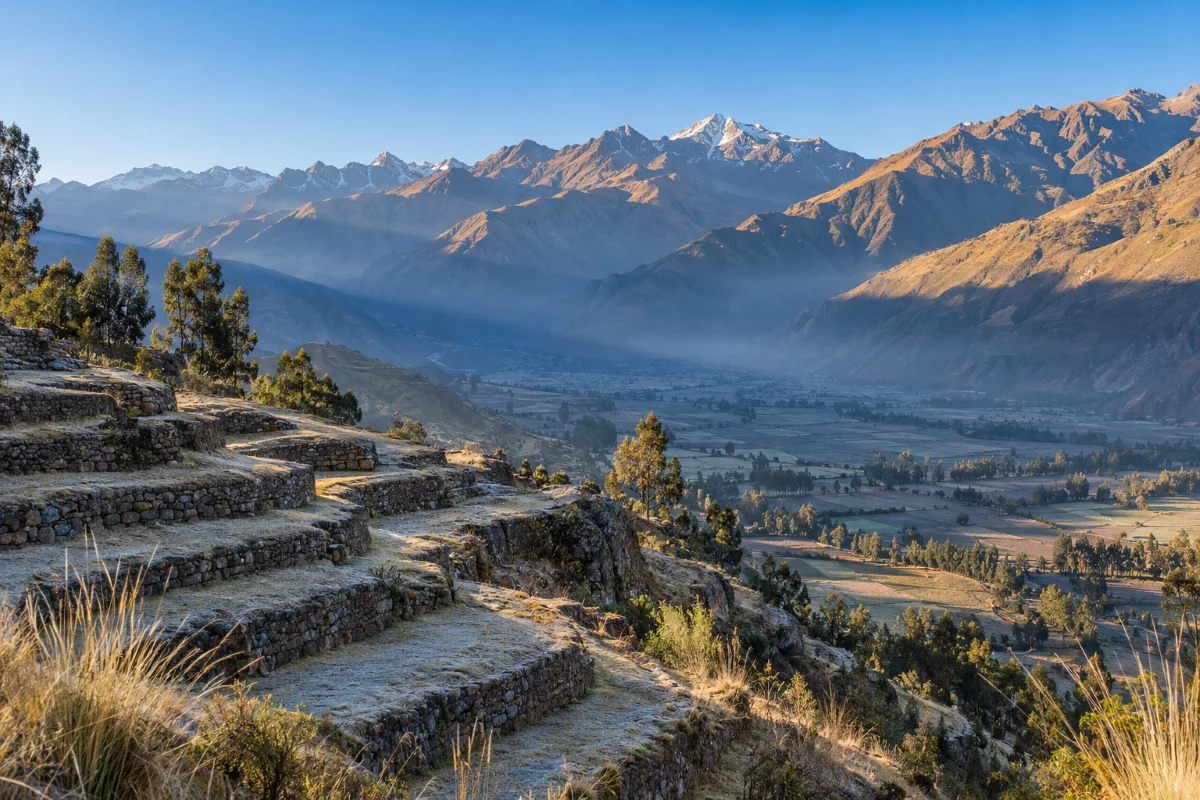
The ayahuasca afterglow is the stretch of unusually good weeks that follows a ceremony, and researchers put it at 1 day to 1 month. It is not 1 effect. It is at least 8 separate ones, and they fade at different speeds. The mood lift and the drop in stress are the parts that tend to hold for a month. The clarity, the flexibility, the sense that you can see your whole life at once, those are mostly gone inside 48 hours. Which matters, because the second group is what people make decisions on.
We have run more than 700 ceremonies at 2,900 meters in Peru’s Sacred Valley since 2017, and we measure every guest at intake, on day 12, and again at 3 months. Day 12 sits inside the afterglow window. The 3-month reading sits well outside it. That gap is the most useful thing we own, and I will give you both numbers below.
What is the ayahuasca afterglow?
The ayahuasca afterglow is the subacute period after a ceremony when mood, wellbeing and openness sit above baseline. A 2023 systematic review in Therapeutic Advances in Psychopharmacology pooled 48 studies and 1,774 participants and defined that subacute window as 1 day to 1 month after drinking. Ricarda Evens and colleagues found reduced symptoms, higher wellbeing and more mindfulness across it.
Worth knowing where the popular figure comes from. You will read everywhere that the afterglow lasts 2 weeks to a month, usually credited to Walter Pahnke. I went and read Pahnke’s 1969 paper. The word afterglow appears once, describing a patient who carried it “into the evening.” No 2-week figure, no month. The Evens review is honest about this: it calls the 2-weeks-to-a-month description a narrative account, not a measurement. So the number the whole industry repeats was never a finding.
How long does the ayahuasca afterglow last?
Between 1 day and 1 month, depending on which effect you are asking about. There is no single end date, and anyone who gives you one is guessing. The honest answer is that different parts of it run on different clocks.
The best evidence on ayahuasca specifically comes from Uthaug and colleagues, published in Psychopharmacology in 2018. They tested 57 drinkers the day after a ceremony and got 31 of them back 4 weeks later. Depression scores fell 46% the day after and were still lower at 4 weeks. Stress fell 36% and also held. Convergent thinking improved 9% the day after and 29% by week 4, so it actually got stronger.
Then the other half of the same study. Satisfaction with life rose the day after and was no longer significant at 4 weeks. The mindfulness gains, observing, non-judgment, awareness, all rose the day after and none of them survived to week 4.
The afterglow is not 1 thing
Treat it as a single glow that dims on a single schedule and you will misread your own recovery, the same way collapsing 3 separate clocks into 1 misreads the night itself. The research describes a bundle of effects with separate half-lives. Here is what the published record actually shows.
| What changed | Day 1 | Week 4 | Where the number comes from |
|---|---|---|---|
| Depression | Down 46% | Still lower | Uthaug 2018, n=57 then 31 |
| Stress | Down 36% | Still lower | Uthaug 2018 |
| Convergent thinking | Up 9% | Up 29% | Uthaug 2018 |
| Satisfaction with life | Up | Gone | Uthaug 2018 |
| Mindfulness, 3 facets | Up | Gone | Uthaug 2018 |
| Creativity and flexibility | Up | Not sustained | Evens 2023, 7 studies |
| Anxiety | No change | No change | Evens 2023, ayahuasca specifically |
Read the last row twice. The Evens review found subacute anxiety reductions for psilocybin, for LSD and for 5-MeO-DMT, and states plainly that it did not find them for ayahuasca. Every retreat page selling ayahuasca for anxiety is selling something the pooled evidence does not currently support. That includes pages that link to studies. They link to the psilocybin ones.
The clarity goes first, and that is the part everyone quotes
Cognitive flexibility is the single most-cited afterglow finding in the retreat industry, and it is also the effect with the shortest measured life. That is not an accident of the writing. It is an accident of when people ran the tests.
The study everyone quotes is Murphy-Beiner and Soar, Psychopharmacology, 2020. It tested 48 people before ayahuasca and again within 24 hours. Mindfulness rose on 4 of 5 measures. Cognitive flexibility improved on 2 separate tests. Real result, honestly reported, and the authors note they had no record of dose or brew composition. But the follow-up window was 1 day. Across the 7 studies in the Evens review that measured creativity and flexibility, the increases were limited to the earliest part of the window and were not sustained at later assessments.
So the field’s favorite proof of lasting change was measured before the change had a chance to not last. Sampedro and colleagues’ 2017 brain imaging work is the counterweight worth naming: 16 volunteers, scanned within 24 hours, and the post-acute changes predicted sustained non-judgment in the 14 who came back at 2 months. Something does persist. It is narrower than the marketing suggests.
Does a harder ceremony produce a better afterglow?
The evidence points that way, which surprised me. The rough nights predicted the better weeks, and the beautiful mystical ones predicted less than you would think.
Sharon Sznitman and colleagues published an ecological momentary assessment study of an ayahuasca retreat in Psychopharmacology in 2025. They pinged 36 participants 3 times a day for 5 days before and 5 days after, and collected 936 of a possible 1,080 responses, which is unusually complete for this kind of work. Positive affect rose, negative affect fell, mindfulness rose. Then the interesting part: grief during ceremony predicted higher positive affect afterward. So did isolation. So did physical suffering. Mystical experience predicted neither reduced negative affect nor mindfulness gains at all, which is the same pattern we get from the scales that predict who improves: none of them ask what you saw.
I would not stretch that into a promise. It is 36 people over 10 days. But it lines up with what we see across 4 nights rather than 1, and it is the opposite of what guests assume when they arrive hoping for a beautiful ceremony. The night people describe as the worst is often the one they credit 6 months later.
What goes wrong inside the window
Headaches, broken sleep and stretches of real distress, and roughly half the published studies never checked. The afterglow gets sold as a month of bliss. The literature describes something less tidy.
Of the 48 studies in the Evens review, only 25 reported assessing adverse events at all. Among those that did, headache was the most common complaint at 52 cases, usually lasting no more than 1 to 2 days. Then sleep disturbance and insomnia at 6 cases, tension at 6, exhaustion at 3, visual distortion at 3. There was 1 severe anxiety exacerbation, and 1 psychiatric disturbance that ran a week. Worth noting what is not on that list: the brew’s drug interactions are largely over by then, and the MAOI window closes in hours, not weeks. No deaths, no suicides, no full psychotic episodes anywhere in the pooled sample.
The longer tail is real too. A 2023 mixed-methods study in PLOS ONE surveyed 608 people reporting extended difficulties after psychedelic use. About a third were still dealing with them a year on. Shorter difficulty was predicted by knowing your dose and your substance, and a narrower range of difficulty by having taken it in a guided setting. Note who co-authored that paper: Ashleigh Murphy-Beiner, whose afterglow study the industry quotes. Same researcher, both ends of the window.
Our own version of that number, since almost no center publishes one. In 9 years, 12 to 15 guests have used our emergency line for a serious crisis after they flew home. Every one resolved with more support. None needed psychiatric hospitalization. That is out of roughly 2,000 guests, and I would rather print it than let you assume it is zero.
Is that headache the afterglow or the altitude?
At 2,900 meters it is a real question, and it is the 1 part of this subject no lowland retreat has to think about. Headache is the most reported complaint in the afterglow literature. Headache is also the symptom you cannot have altitude sickness without.
The 2018 Lake Louise criteria score acute mountain sickness across 4 symptoms: headache, gastrointestinal upset, fatigue or weakness, and dizziness. A total of 3 or more with the headache present is a diagnosis. Sleep disturbance, which is the second most common afterglow complaint, was dropped from the scored items in that revision, so it tells you less than people think.
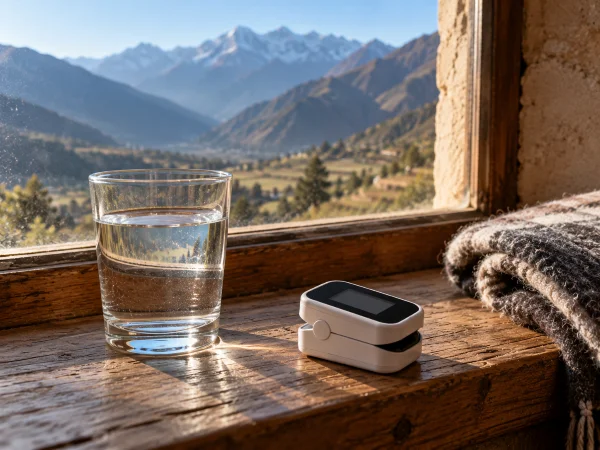
How we separate them in practice. A pulse oximeter, in the room, and a medical director with altitude medicine training from the Instituto de Investigaciones de Altura in La Paz. Low oxygen saturation at this elevation can look a great deal like panic, and it can look a great deal like a bad morning. A reading takes 20 seconds and it answers the question that guessing cannot. We build 2 acclimatization days in before anyone drinks for the same reason, and the screening list altitude adds is longer than the one lowland centers run.
To be exact about what I am claiming: no trial has tested ayahuasca at altitude. Nobody knows whether the afterglow itself differs up here. What I am saying is narrower and checkable. The most common complaint in the afterglow literature is the same complaint that starts an altitude diagnosis, and if you are at 2,900 meters you need a way to tell them apart.
What our day-12 numbers show in 2026
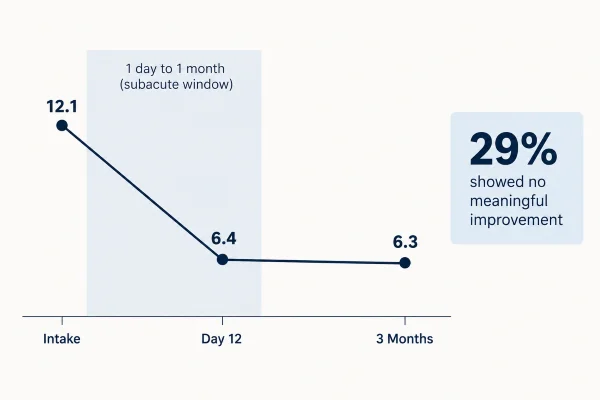
Our day-12 average held almost exactly at 3 months, and the average lied about 29% of our guests. Both of those are true at once, and the second one is why I do not trust an afterglow measurement on any individual.
Since 2020 we have collected PHQ-9 and PCL-5 scores at intake, on day 12 of the retreat, and again at 3 months. Roughly 310 complete datasets. Day 12 falls inside the subacute window the Evens review defines. The 3-month reading falls outside it. Very few places measure both, and the review names the consolidation of subacute benefit as the open question in the field.
| Measure | At intake | Day 12, inside the window | 3 months, outside it |
|---|---|---|---|
| PHQ-9, depression | 12.1 | 6.4 | 6.3 |
| PCL-5, guests above the clinical cutoff | 46.8 | Not recorded | 34.2 |
A 5-point PHQ-9 change is clinically meaningful, so a 5.8-point drop that holds is a real result, and 71% of guests showed sustained improvement. Then the part that matters here: 29% showed no meaningful improvement at 3 months. Their day-12 scores were inside that group average. The afterglow told them something that did not come true.
This is observational data from people who chose to come and chose to reply, not a trial. It also runs alongside a shape you can see in the published work: a 2022 naturalistic study in Frontiers in Pharmacology followed 53 people and found depression lowest at day 7, then drifting back by week 4. We wrote about what the first month home asks of you separately, and about what the depression research does and does not show.
What not to decide in the first 2 weeks
Do not quit the job, end the relationship, book the next retreat or write the review. The afterglow is the worst window in which to make a decision about your life, and the research the retreat industry quotes to sell it is the research that says so.
Line the findings up. Flexibility and creativity are elevated and about to drop. Life satisfaction is elevated and will not hold 4 weeks. Mindfulness is elevated and will not hold either. Meanwhile the capacity that does improve, lower depression and lower stress, is not a decision-making faculty. It is a mood. You are at your most certain precisely where the measurements say you are least stable.
What we ask guests to do instead: write the decision down, date it, and look at it in 6 weeks. The ones who do that mostly still want the change, and they make it better. The ones who act in week 1 sometimes spend month 3 undoing it. And on reviews, which is a smaller thing with the same shape, a 5-star review written on day 4 is measuring a mood, not a retreat.
Our integration program is built around that gap on purpose. A call in week 1, a follow-up in week 3, an email check-in at weeks 6 to 8, then surveys at months 3, 6 and 12. About 85% of guests take the week 1 call and about 40% are still answering at month 6, which is honest rather than flattering. The weeks that decide the outcome are 2 through 6, and they are the weeks nobody feels like doing anything.
Frequently asked questions
How long does the ayahuasca afterglow last?
Between 1 day and 1 month, and it depends which effect you mean. A 2023 systematic review of 48 studies and 1,774 participants set that window. Within it, depression and stress reductions held at 4 weeks in the one ayahuasca study that retested the same people, while mindfulness and life satisfaction gains did not.
What is the ayahuasca afterglow supposed to feel like?
Lifted mood, less stress, more openness to other people, and a sense of unusual clarity. The clarity is the least durable part. Across 7 studies that measured creativity and flexibility, the gains showed up in the first 1 to 2 days and were not sustained later in the window.
Does the afterglow mean the ayahuasca worked?
No, and our own numbers are the clearest answer we have. Across roughly 310 guests our average PHQ-9 was 6.4 on day 12 and 6.3 at 3 months, so the group held. But 29% of guests showed no meaningful improvement at 3 months, and their day-12 scores sat inside that same average.
Can the ayahuasca afterglow feel bad?
Yes. In the pooled review, headache was the most reported complaint at 52 cases, followed by sleep disturbance, tension and exhaustion. Only 25 of the 48 studies checked for adverse events at all, so the real rate is probably higher than the published one. Nothing in the pooled sample was fatal.
Why do I feel flat at week 6?
Because the subacute window has closed and your ordinary life has started again. A 2022 study of 53 people found depression scores lowest around day 7 and drifting back by week 4. The drift is not the retreat failing. It is the point at which the work moves from the medicine to you.
Should I book another retreat while I still feel good?
Wait 6 weeks and see if you still want to. Booking in the afterglow is the most common version of a decision made on an elevated measure that is about to drop. In our experience the guests who chase the state do worse than the guests who sit through the flat part.
Is a headache after a ceremony at altitude normal?
It is common in both the afterglow literature and at 2,900 meters, which is exactly the problem. The 2018 Lake Louise criteria require a headache for an altitude sickness diagnosis, scored with gastrointestinal upset, fatigue and dizziness to a total of 3 or more. A pulse oximeter reading settles it in 20 seconds.
The afterglow is worth having and it is not the result. If you want to know whether you are cleared to drink at 2,900 meters in the first place, our physician reads every application before you pay anything, and you can start that conversation here or read how our Sacred Valley center runs a 12-day retreat around it.
This article is for information only and is not medical advice. Talk to your own doctor about your medications and conditions before applying to any ayahuasca retreat.