Ayahuasca Ego Death: The 4 Things Measured
Ayahuasca ego death is the temporary loss of your ordinary sense of self during ceremony. Researchers call it ego dissolution, and they measure it with an 8-item scale. Here is what almost every page on this topic misses: it is not 1 experience. The research measures 4 separate things, and 2 of them point in opposite directions. The calm version predicts better outcomes. The frightened version predicts worse ones. And in the only ayahuasca study that followed people for a month, how far a person’s sense of self came apart had stopped predicting how they felt by week 4. We have run more than 700 ceremonies at 2,900 metres over 9 years. Below is the evidence, plus what we do at 2 AM when someone says they are dying.
What Is Ayahuasca Ego Death?
It is the experience of your sense of being a separate self thinning out or disappearing for a while, usually at the peak of a ceremony. The self comes back. Nobody in the published research stayed dissolved.
Ego death, also called ego dissolution, is a temporary loss of the ordinary sense of self during a psychedelic experience. Nour and colleagues built an 8-item scale for it in 2016, validated on 691 people reporting 1,828 drug experiences. Sample items: “I experienced a dissolution of my self or ego” and “all notion of self and identity dissolved away.”
That scale matters more than any description of the feeling, because it is what researchers use when they test whether the experience does anything. Scores ran with dose for psychedelics and not for alcohol. Higher scores went with people reporting better wellbeing afterward. Those are correlations in a survey, not proof that one caused the other, and the authors say so.
Ego Dissolution And Ego Death Mean The Same Thing
Same experience, 2 names. “Ego death” is what people say in ceremony circles. “Ego dissolution” is what appears in the papers, because researchers wanted a term that did not imply anyone died.
Worth being plain about the ego part too. In this context the ego is not arrogance. It is the ordinary background sense that there is a you in here and a world out there. That sense is doing a job. It goes quiet for a few hours and then it comes back, which is why nobody serious calls this death.
The 4 Things The Research Measures
Four separate constructs get folded into the phrase “ego death,” and they behave differently. One of them predicts you will do better. One predicts you will do worse. They are measured with different instruments, in different studies, and the field keeps quoting them as if they were interchangeable. Loss of self also sits inside the 30-item scale that predicts who improves, which is why what you saw matters less than what happened to you.
| What it is | How it gets measured | The number | What it predicts |
|---|---|---|---|
| Ego dissolution. Your sense of being a separate self thins or goes. | Ego Dissolution Inventory, 8 items, 0 to 100 | Mean 60 out of 100 in 57 ayahuasca drinkers | Ran with dose. Ran with next-day mood. Mostly stopped predicting by week 4 |
| A personal death experience. A convincing sense that you are dying or already dead. | Direct yes or no questions, then follow-ups on frequency and effect | 66.7% of 54 veteran drinkers, 49.2% of 305 less experienced ones | Large shifts in how people think about death. Not predicted by ego dissolution scores |
| Oceanic boundlessness. Unity, peace, timelessness, a sense of the sacred. | Altered States of Consciousness questionnaire | Standardised beta 0.605 in 20 patients on psilocybin | Better depression scores 5 weeks later |
| Dread of ego dissolution. Panic, loss of control, thinking coming apart. | Same questionnaire, different subscale | Standardised beta -0.649 in those same 20 patients | Worse depression scores 5 weeks later |
Read the last 2 rows again. Same scale, same 20 patients, same session, opposite signs. Together those 2 subscales explained 54% of the variance in how much better people got. That is the finding the retreat industry leaves out when it sells depth.
How Common Is Ego Death On Ayahuasca?
For the closest thing anyone has measured, roughly half of ayahuasca drinkers, and the figure depends heavily on which group you ask. A 2023 study in Frontiers in Psychiatry asked 2 different samples about a convincing sense of dying during ceremony, and got 2 different answers.
| Sample | Reported it | Said their view of death changed a lot |
|---|---|---|
| 54 long-term, experienced drinkers | 36 people, 66.7% | 77.8% |
| 305 less experienced drinkers | 150 people, 49.2% | 42% |
The 66.7% figure is the one that travels around the internet. It comes from veterans. In the bigger, less experienced sample the rate drops to 49.2% and the share reporting a large change in their attitude toward death nearly halves. If you are booking your first retreat, the second row is your row.
Frequency is worth knowing too. Among those 150 people, 80.7% had it between 1 and 5 times across their whole history with the medicine, and 6.7% had it more than 10 times. So even among people it happens to, it is not a normal Tuesday.
One caution I have to give, because the authors give it: a personal death experience and ego dissolution are not the same measure. They ran the 8-item dissolution scale alongside the death questions specifically to separate them, and found effects that belonged to one and not the other. Nobody has published a clean prevalence rate for ego dissolution itself in ayahuasca ceremonies. Anyone who tells you the exact percentage is guessing.
How Long It Lasts, And Why Nobody Has Measured It
Nobody has timed it. Not one study reports how many minutes ego dissolution lasts, which is why every page you have read says “a few minutes to a few hours” and cites nothing. What is measured is the drug, and that gives you the outer edge.
Ayahuasca runs 4 to 6 hours, with the strongest part early. So the window sits inside the peak, not across the night. Here is our clock at 2,900 metres, which is the part I can speak to directly. The cup goes out between 8:45 and 9:00 PM. Don Julio puts the candle out at 9:00. Onset at this elevation runs 15 to 20 minutes slower than what guests who have drunk at sea level expect. The heavy stretch is 9:30 PM to about 12:30 AM. If dissolution happens, it happens in there. By 2:30 AM the singing has gone quiet and people are mostly lying still.
The thing that lasts is not the episode. It is what you remember of it, which is a different claim and a weaker one.
The Frightened Version Predicts Worse Outcomes
This is the part I would want to know before drinking. In the only study to measure both sides, the panicked form of dissolution predicted worse results, not slower results. Roseman, Nutt and Carhart-Harris tracked 20 patients with treatment-resistant depression through 2 psilocybin sessions of 10 mg and 25 mg, in Frontiers in Pharmacology in 2018. They scored the big session on 2 subscales: oceanic boundlessness and dread of ego dissolution.
Oceanic boundlessness came out at a standardised beta of 0.605 against depression scores 5 weeks later. Dread of ego dissolution came out at -0.649. The authors write that greater dread during the session “was predictive of less positive clinical outcomes.”
That is 20 people on psilocybin, not 200 people on ayahuasca, and I am not going to pretend it settles anything. But it is the best evidence anyone has on this question, and it runs against the story that a terrifying night is a harder road to the same place. In that dataset it was a different road.
What Was Still There 4 Weeks Later
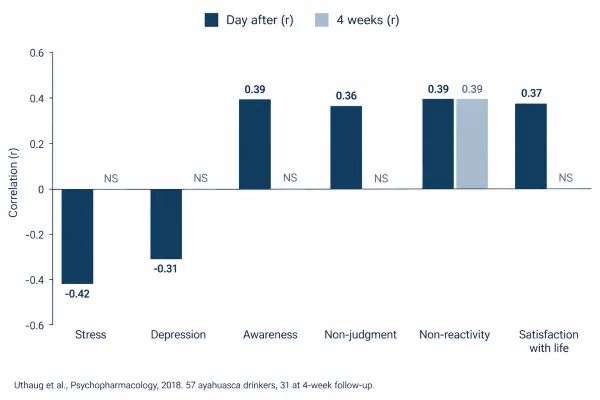
One correlation out of 6. Uthaug and colleagues measured ego dissolution in 57 people at ayahuasca ceremonies in 2018, average score 60 out of 100, then followed 31 of them for 4 weeks.
The morning after, how far someone’s sense of self had come apart tracked how they felt on 6 different measures. Stress was the strongest link (r = -0.42). Depression, awareness, non-judgment, non-reactivity and satisfaction with life all moved with it too, in the 0.31 to 0.39 range.
At 4 weeks, 5 of those 6 links were gone. The one that held was non-reactivity, the capacity to notice a feeling without being dragged along by it (r = 0.39). Depression and stress were still lower than baseline across the group, so the medicine had not stopped working. What stopped was the connection between the depth of the dissolution and the benefit.
I read that as the most useful sentence in this whole field. The part that lasted was not the dissolution. It was a skill that dissolution seems to teach, and skills need practice, which is the entire argument for taking the 6-week countdown and the months afterward seriously.
What Happens At 2 AM At 2,900 Metres In 2026
Someone says “I am dying” and we treat it as 2 questions at once, because at this elevation it can be either. One is psychological and expected. The other is oxygen, and it is not.
A facilitator reaches the mat first and speaks before touching anyone. Feel the mat. Feel the stone wall behind you. I am right here. One of the 3 healers comes over and sings directly at the person, which Don Julio calls singing the fear out. If breathing is fast and shallow, or the person is not responding, the facilitator calls Dr. Carlos Medina Vargas on the walkie-talkie. He is on site during every ceremony block and reaches a mat in 2 to 3 minutes with a pulse oximeter, and the first thing he checks is oxygen saturation. We keep 3 oximeters, 2 portable oxygen tanks and a Gamow bag in the maloca for that reason.
A jungle center does not have to make this call. We do, and the reason is simple arithmetic: panic and thin air produce overlapping symptoms, and you cannot talk someone through a low reading. His certification in altitude medicine from the Instituto de Investigaciones de Altura in La Paz is the reason he can tell them apart in the dark.
Is any of this psychosis? Almost never. In 9 years and about 2,000 guests we have had 1 acute psychotic episode in ceremony, a guest in his 40s in November 2022, 90 minutes in, stabilised in about 20 minutes with intramuscular diazepam and oxygen and evacuated the next morning with a full recovery. He later told us his father had been diagnosed with schizophrenia and he had left it off his form. First-degree family psychiatric history is now a required disclosure, and it sits with the 7 disqualifiers we publish. Dissolution and psychosis look different from the outside: one ends when the medicine does, the other does not.
Should You Try To Make It Happen?
No, and the research on adverse effects is the reason. The Global Ayahuasca Survey, 10,836 people in more than 50 countries, found that adverse mental health effects afterward were more likely in the people who had the strongest acute spiritual experience.
The numbers from that survey, published in PLOS Global Public Health in 2022: 69.9% had a physical adverse effect, 2.3% needed medical attention, and 55.9% reported an adverse mental health effect in the weeks or months that followed. About 12% went and got professional support for it. About 88% of that group still counted the whole thing as part of something worthwhile. So this is not an argument that the hard parts ruin people. It is an argument that intensity has a bill attached, and chasing intensity means volunteering to pay it.
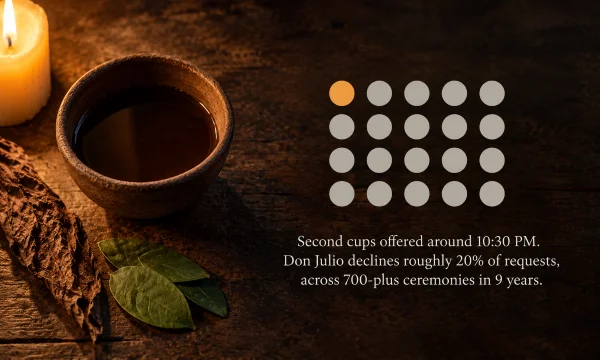
Here is where that becomes an operational decision rather than a philosophical one. A second cup gets offered around 10:30 PM. Don Julio turns down roughly 20% of the requests. He reads each guest with a coca leaf for about 30 seconds before pouring anything, a practice he calls hampi qhaway, and he has the final say on every dose, including refusing to serve someone at all on a given night. That has happened 3 times in 9 years. Two of those 3 drank later in the week and had strong ceremonies.
The guest who wants dissolution is usually the guest asking for more. That is the same instinct as why we serve only one medicine in a retreat instead of 4.
How To Prepare For Ego Death
You cannot prepare for the dissolution. You can prepare for the fear, and since fear is the variable with the worst track record in the research, that is where the work belongs. Almost no page in this field says anything at all about preparation, which is strange, because it is the only part you control.
Four things, in the order they matter.
Name the specific fear, on paper, before you fly. Not “I am scared of ego death.” Closer to “I am scared I will not come back” or “I am scared of what I will find out about myself.” Vague fear cannot be answered. A specific one usually can be, and our facilitators can answer most of them with a fact.
Practise letting go of control somewhere low-stakes. Meditation, breathwork, long walks without your phone. You are training the nervous system to sit still while something uncomfortable happens. That is the skill the 4-week data points at.
Write an intention that leaves room to be surprised. An intention that reads like a demand sets you up to fight the night when it goes somewhere else. Ours is a 4-week preparation window, and the writing is most of it.
Tell your screening call the truth. We reject 13% of applicants outright, and the rejections exist so that the person next to you at 2 AM is someone the medicine can hold. Every applicant does a 30 to 45 minute video call before anything is confirmed, and Dr. Medina reads every medical form within 72 hours. Leaving something off that form is the one preparation mistake we cannot fix at altitude.
What we do not do is promise depth. Our 12-day retreat runs 4 ceremonies, on nights 4, 6, 9 and 11, with 2 acclimatisation days before the first one. Nobody can tell you which of those 4 nights will take the floor out from under you, or whether any of them will.
What If It Never Happens To You?
Then you are in the majority on any given night, and the outcome data does not care. Across about 310 guests with complete 3-month follow-up, PHQ-9 depression scores went from 12.1 at intake to 6.4 on day 12 and 6.3 at 3 months, with 71% holding the improvement. We do not record how far anyone’s sense of self came apart, so I cannot tell you whether the 71% had more dissolution than the 29% who did not improve. Nobody else can tell you either, and most will imply they can.
Between 5% and 8% of ceremony opportunities here get sat out, with no pressure either way, and guests whose first 2 nights are quiet often open on the third. The pattern that shows up after about 2,000 guests is not about diagnosis or dose. The people who struggle most are the most rigid, not the sickest. What changes across a week looks more like night 1 against night 4 than like one big event.
Chasing ayahuasca ego death is the one goal I would ask you to put down before you arrive. If it comes, the people in the room have seen it a few hundred times, and Don Julio has been doing this for 50 years. You can read about him and the rest of the team on our about page, or apply for a 2026 retreat and we will start with the screening call.
Frequently Asked Questions
What is ayahuasca ego death?
It is the temporary loss of your ordinary sense of self during a ceremony, usually at the peak. Researchers call it ego dissolution and score it on an 8-item scale built by Nour and colleagues in 2016 and validated on 691 people. In 57 ayahuasca drinkers measured the day after ceremony, the average score was 60 out of 100. It ends when the medicine does.
How common is ego death on ayahuasca?
Roughly half of drinkers report the closest thing anyone has measured, a convincing sense of dying during ceremony. A 2023 study found it in 66.7% of 54 long-term drinkers but only 49.2% of 305 less experienced ones. No study has published a clean prevalence figure for ego dissolution itself in ayahuasca ceremonies.
How long does ego death last?
No study has ever timed it. What is known is the drug: ayahuasca runs 4 to 6 hours with the strongest stretch early, so the window sits inside the peak. At our center the cup goes out around 9 PM and the heavy part runs until about 12:30 AM.
Is ego death dangerous?
The dissolution itself is temporary and self-limiting. The risk sits in the weeks afterward and in the panicked version of it. Across 10,836 people in the Global Ayahuasca Survey, 55.9% reported an adverse mental health effect afterward and about 12% sought professional support, though about 88% of those still counted the experience as worthwhile. At altitude there is a second question, because panic and low oxygen share symptoms, which is why our physician checks oxygen saturation first.
Can you make ayahuasca ego death happen?
Not reliably, and pushing for it is a poor bet. Dread of ego dissolution predicted worse depression outcomes at 5 weeks in the one study that measured both sides of the experience. Our lead healer declines roughly 20% of second-cup requests for this reason, and he decides every dose himself.
Does ego death mean the ceremony worked?
No. In the only ayahuasca study with a 4-week follow-up, 5 of the 6 links between how far the self dissolved and how people felt had disappeared by week 4. The one that held was non-reactivity. Among our own 310 guests with 3-month data, depression scores fell 5.8 points on average and 71% held that improvement, and none of that is recorded against how anyone’s ceremony felt.