Ayahuasca Vs Ketamine: Same Response Rate, Different Clock
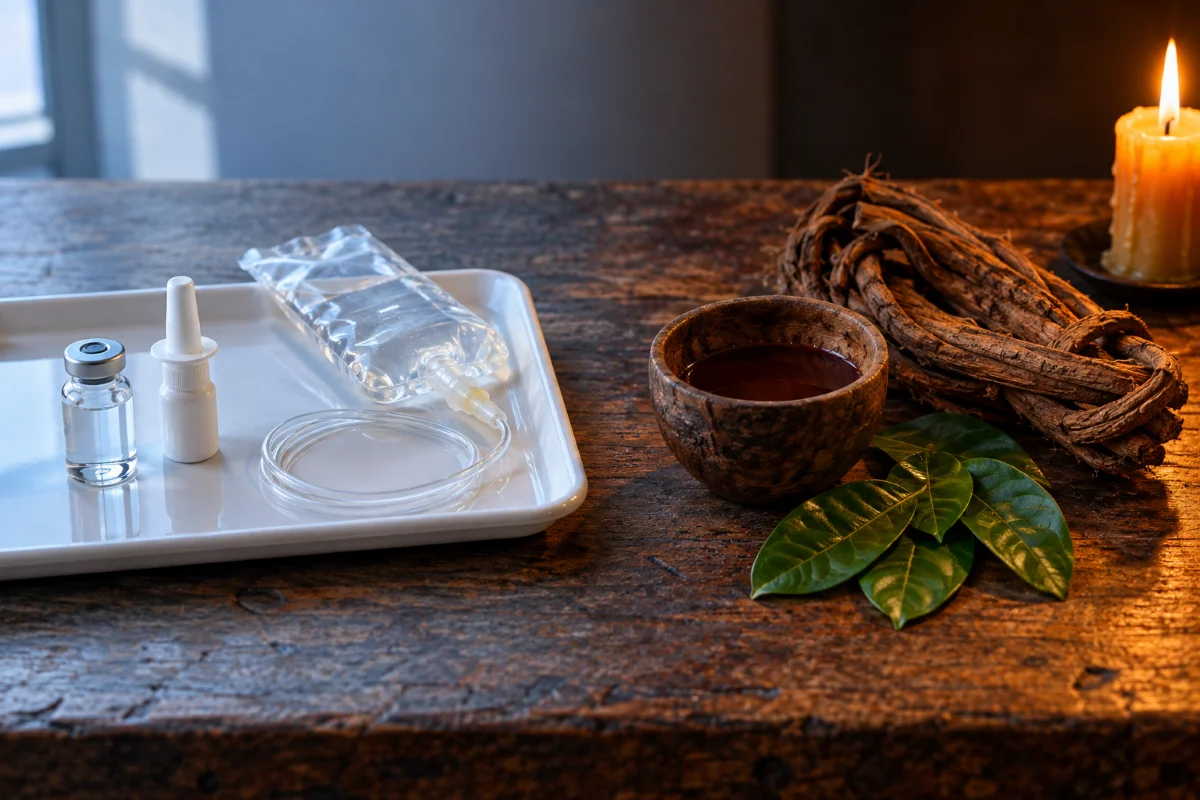
Ayahuasca vs ketamine comes down to speed, setting and how much proof you want. Retreat sites frame it as healing against escape, and the trials don’t support that. In a 73-person randomized trial, 64% of people with hard-to-treat depression responded to 1 ketamine infusion within 24 hours. In the only randomized ayahuasca trial we could find, 64% responded by day 7. Ketamine is faster, FDA-approved as a nasal spray, and far better studied. Ayahuasca takes a night in ceremony and weeks of preparation, and no controlled trial has followed it past day 7. We found no trial that tests the 2 head to head.
We run Cusco Ayahuasca Retreats, so read this knowing which side we sell. This page still tells you when ketamine is the better call, and who we turn away.
What’s the Difference Between Ayahuasca and Ketamine?
Ayahuasca and ketamine are 2 drugs people try when standard depression treatment hasn’t worked. Ketamine is an anesthetic, taken by IV drip or esketamine nasal spray in a monitored clinic, and it acts within a day. Ayahuasca is a brew of the caapi vine and chacruna leaf, drunk in an all-night ceremony. Its effects last 4 to 6 hours.
| Ketamine | Ayahuasca | |
|---|---|---|
| What it is | An anesthetic, first FDA-approved in 1970 | A brew of 2 Amazonian plants |
| Active drug | Ketamine, or esketamine in the nasal spray | DMT, made active by the vine’s MAO inhibitors |
| How it acts | Blocks NMDA receptors | Acts on serotonin 2A receptors |
| How you take it | IV drip over about 40 minutes, or a nasal spray | Drunk from a cup at night |
| Who watches you | Clinic staff, with at least 2 hours of monitoring after each spray dose | Healers and facilitators, and at our center a physician on site |
| Legal status | US Schedule III; the spray is FDA-approved for depression | DMT is US Schedule I; Peru declared traditional use national heritage in 2008 |
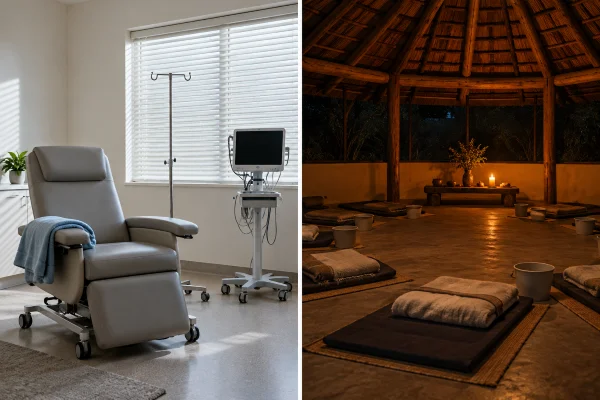
The table leaves out the biggest difference, which is who’s in the room and for how long. Ketamine happens in a clinic chair. Ayahuasca at our center happens on a mat in a group of up to 14, with 3 healers and 2 facilitators, from about 8 PM to 3 AM.
How Fast Each One Works
Ketamine works in hours and ayahuasca in days. In the 2 trials below, both reached a 64% response rate, but ketamine got there at 24 hours and ayahuasca at day 7.
| Trial | People | Drug | Control | Measured at | Responded on drug | Responded on control |
|---|---|---|---|---|---|---|
| Murrough and colleagues, 2013 | 73 | 1 IV ketamine infusion | midazolam | 24 hours | 64% | 28% |
| Palhano-Fontes and colleagues, 2019 | 29 | 1 dose of ayahuasca | placebo | day 7 | 64% | 27% |
Response means depression scores fell by half or more on the same scale, the MADRS. In a 73-person trial published in the American Journal of Psychiatry in 2013, 64% responded to IV ketamine at 24 hours, against 28% on midazolam. Midazolam is a sedative. It was used so the control group would feel something too.
The ayahuasca trial has a detail most pages skip. On day 2, 77% of the ayahuasca group met the response bar, and so did 64% of the placebo group. The groups only pulled apart by day 7. Both went through the same dosing session, and only 1 group got the brew. So if a retreat promises you’ll wake up different, some of that change is likely the room and your own expectations.
Speed also means hours out of your day. An IV ketamine infusion runs about 40 minutes. Esketamine patients stay at least 2 hours after every dose. Ayahuasca’s effects run 4 to 6 hours inside a ceremony that opens at 8 PM and closes around 3 AM. The drug clock and the ceremony clock differ, and how long ayahuasca lasts depends on which one you mean.
Ayahuasca vs Ketamine: Which Lasts Longer?
Nobody knows yet. Ketamine’s fade has been measured in controlled trials, and it shows up in days to weeks. Ayahuasca’s staying power has only been tracked without a control group.
| Study | Design | What happened later |
|---|---|---|
| 1 ketamine infusion, 73 people, 2013 | randomized, with an active control | by day 7, the gap with the control group was no longer statistically significant |
| Up to 6 ketamine infusions in 12 days, 24 people, 2013 | no control group | 70.8% responded; responders relapsed a median of 18 days after the last infusion |
| 1 dose of ayahuasca, 29 people, 2019 | randomized, with a placebo | measuring stopped at day 7 |
| 1 ayahuasca ceremony, 280 people in Brazil, 2026 | no control group | depression scores fell by about half by day 21, then rose about 3.5 points by day 180 |
| IV DMT alone, 34 people, 2026 | randomized for 2 weeks, then open | the gains held to 3 months |
| 4 ayahuasca ceremonies over 12 days, about 310 of our guests | our own follow-up, no control group | PHQ-9 of 12.1 at intake, 6.4 on day 12, 6.3 at 3 months |
The randomized ayahuasca trial in the trial table above, a 29-person trial run in Brazil and published in Psychological Medicine in 2019, stopped measuring at day 7. That’s where the controlled evidence ends. The ayahuasca research has more holes than 1 table can show, and we pulled apart the most-quoted depression study on a separate page.
This is where we part ways with most retreat marketing. Calling ketamine an escape and ayahuasca real healing isn’t backed by any trial. Ketamine is the better-measured drug, and its fade shows up because researchers kept measuring. Ayahuasca’s staying power may look better partly because nobody has measured it against a control group.
The newest data does lean toward psychedelics lasting longer per dose. In a Nature Medicine trial published in February 2026, 34 people got IV DMT, the main psychedelic compound in ayahuasca, and their gains held for 3 months in the trial’s open phase. That was DMT alone, infused into a vein, without the vine. It’s a reason to keep watching, and it says nothing direct about the brew.
Is Ketamine a Psychedelic Like Ayahuasca?
Not in the classic sense. Ketamine is a dissociative that blocks NMDA receptors, while the DMT in ayahuasca is a classic psychedelic that acts on serotonin receptors. In the lab, though, the 2 did something similar to brain cells.
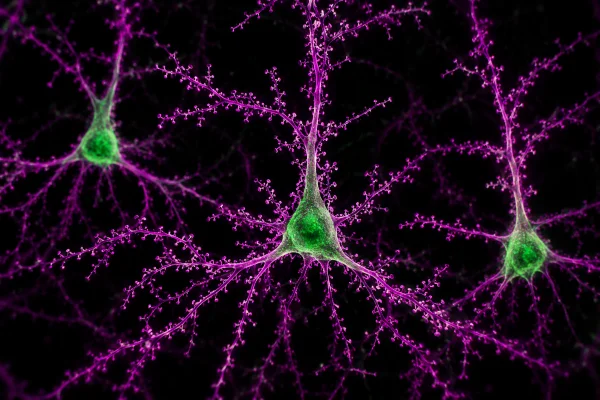
In a 2018 study in Cell Reports, researchers at UC Davis gave rats DMT or ketamine at the same dose. 24 hours later, DMT had increased the dendritic spines on brain cells, the small bumps where cells connect, by an amount comparable to ketamine. The study used rats, and nobody has shown the same in people. It still undercuts the idea that 1 drug works on the brain and the other works on the soul.
The experience is where they split. An infusion takes about 40 minutes, while what ayahuasca feels like shifts across 4 to 6 hours and from night 1 to night 4. The esketamine label lists dissociation, feeling detached from yourself or your surroundings, in its boxed warning. Ayahuasca brings purging, which means vomiting, and visions that range from nothing at all to overwhelming.
Time, Cost and Setting, Side by Side
Ketamine asks for less of your time. Ayahuasca asks for 12 days in Peru and, if you take an antidepressant, 6 weeks of tapering before you fly.
| IV ketamine | Esketamine nasal spray | Our ayahuasca retreat | |
|---|---|---|---|
| Where | Outpatient clinic | Certified clinic or doctor’s office only | Sacred Valley, Peru, 2,900 m |
| Time per session | About 40 minutes of infusion | At least 2 hours of monitoring per dose | About 8 PM to 3 AM, on nights 4, 6, 9 and 11 |
| Price | Set by each clinic | Depends on your insurance | $3,200 private room, $2,600 shared |
| Your antidepressant | Set by your prescriber | Taken alone or with an oral antidepressant | SSRIs and SNRIs tapered for 6 weeks first, 8 for fluoxetine |
The retreat price includes meals and integration, and our retreat format page lists the rest. Flights aren’t included. Lima to Cusco is about 75 minutes by air, and we ask you to land a day early for the altitude.
Ketamine’s hidden cost is repetition. In the 24-person study above, responders relapsed a median of 18 days after their last infusion, which is why maintenance sessions exist. Ayahuasca’s hidden cost is the time and preparation before you ever drink.
Can You Do Ayahuasca If You’re on Ketamine or Spravato?
Yes, with a plan made by your prescriber and our physician. For Spravato patients, the bigger hurdle is usually the antidepressant that comes with it.
Until January 2025, esketamine (sold as Spravato) was only approved alongside an oral antidepressant. If you started it before then, you were prescribed one too, usually an SSRI or SNRI. Those don’t mix with ayahuasca. The caapi vine is an MAO inhibitor, and MAO inhibitors combined with SSRIs can cause serotonin syndrome. So the antidepressant tapers first, over 6 weeks (8 for fluoxetine), with your own prescriber.
I learned why the hard way. In 2018, before we had a doctor on staff, I accepted a guest on a low dose of sertraline because she said she would “skip a few doses.” She spent the night with a racing heart, agitation and tremors, made worse by the altitude. I sat with her all night, scared. She recovered by morning. Within 2 months I’d hired Dr. Medina and rebuilt our screening from scratch.
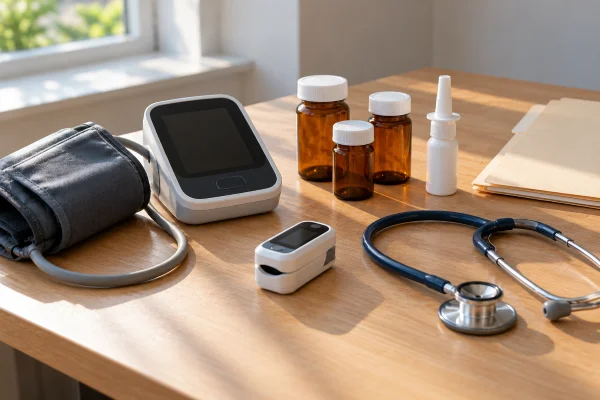
The ketamine side has its own interaction. The FDA’s esketamine prescribing information warns that MAO inhibitors taken with it may raise blood pressure. On its own, esketamine raised blood pressure by 40 points systolic or 25 diastolic, or more, in 3% to 19% of patients, peaking about 40 minutes after a dose and lasting about 4 hours. The label doesn’t mention ayahuasca. The vine is an MAO inhibitor, so the 2 shouldn’t overlap.
| You take | What the FDA says | What we ask |
|---|---|---|
| Esketamine with an SSRI or SNRI | Approved together since 2019; MAO inhibitors may raise blood pressure | Taper the antidepressant over 6 weeks (8 for fluoxetine) with your prescriber, who also sets the date of your last esketamine dose with Dr. Medina |
| Esketamine alone | Approved on its own since January 2025 | Dr. Medina and your prescriber set the date of your last dose before your first ceremony |
| An IV ketamine series | Ketamine is approved as an anesthetic; use for depression is off-label | Dr. Medina and your prescriber set the date of your last infusion before your first ceremony |
| At-home ketamine, such as lozenges or compounded sprays | FDA warned about compounded ketamine for psychiatric use in October 2023 | Tell us the product, the dose and your last date, and Dr. Medina reviews it with your prescriber |
Never stop esketamine or an antidepressant on your own. Ketamine and esketamine get their own rows here; every other window is in our medication taper table.
Mistakes still happen. In 2023, a guest’s undisclosed SSRI came to light in the middle of a retreat. We adjusted the dose and nothing went wrong. It’s why we ask about every medication by name.
Who Should Choose Ketamine Instead
Ketamine or esketamine is the better call in 3 situations: an acute crisis, an antidepressant you can’t safely stop, or no way to be away for 2 weeks.
The FDA approves esketamine, with an oral antidepressant, for depressive symptoms in adults with major depressive disorder who have acute suicidal thoughts or behavior. At our center, active suicidal ideation with a plan is an automatic no. So the people esketamine is approved for include people we turn away. That’s deliberate. A crisis needs stabilizing first, and a 12-day retreat at 2,900 m isn’t built for that.
If that’s you today, don’t wait for either. Call your local emergency number, or in the US, call or text 988.
The other 2 groups are simpler. If your psychiatrist says your antidepressant can’t be tapered, ayahuasca is off the table, while esketamine is approved alongside one. And if you can’t be away for 12 days plus travel, ketamine fits into a normal week.
We turn away 13% of applicants outright, and another 4% to 6% get a conditional yes whose conditions they never meet. That call belongs to the physician who screens every application, not to a salesperson.
The Risks of Each One
Both carry real risks, and they’re different kinds. Esketamine’s are listed on an FDA label. Ayahuasca’s come mostly from large surveys of people who drank it.
The esketamine label carries a boxed warning, the FDA’s strongest, for sedation, dissociation, slowed breathing, abuse and misuse, and suicidal thoughts in young patients. That’s why every dose happens in a certified clinic with at least 2 hours of monitoring.
The Global Ayahuasca Survey, published in PLOS Global Public Health in 2022, is the largest dataset on ayahuasca’s side effects. Of 8,216 drinkers, 69.9% reported a physical side effect and 2.3% needed medical attention. Of 7,839, 55.9% reported a mental health effect in the weeks after, and about 12% of that group sought professional support. Most of that group called it part of a growth process, but self-reports cut both ways.
Altitude adds its own list at 2,900 m. Severe lung disease, sickle cell disease and uncontrolled heart conditions rule people out here even when the brew itself wouldn’t. Across roughly 2,000 guests since 2017, we’ve had no deaths and 1 medical evacuation, in 2022, for a cardiac event made worse by altitude. The guest recovered fully. The full list of who shouldn’t drink ayahuasca, altitude conditions included, has its own page.
What Our 3-Month Data Can and Can’t Tell You
It shows our guests’ depression scores held from day 12 to month 3. It can’t show that ayahuasca caused it, or that the same would happen for you.
Since 2020, every guest fills in the PHQ-9, a standard 9-question depression scale, at intake, on day 12 and at 3 months. Across roughly 310 guests with all 3 scores, the average went from 12.1 to 6.4 to 6.3. A 5-point drop is the usual bar for a change that matters. 71% held their improvement at 3 months. 29% didn’t, and we publish that number too.
Read it with 3 caveats. There’s no control group. The people who answer at 3 months are the ones still in touch, and people who feel better may answer more often. And every guest also gets a year of integration calls, so we can’t separate the brew from the support.
A 280-person study from Brazil, published in Frontiers in Psychiatry in January 2026, saw scores bottom out at day 21 and creep back up by day 180. Ours held flat from day 12 to month 3. The 2 groups differ in people, scale and support, so neither result proves the other. We also don’t set our number against ketamine’s 18-day relapse figure as a win. That study measured something else: time to relapse after a series, not an average at 3 months.
How to Choose Between Them in 2026
Start with your situation: your medications, your time and how stable you are this month. Which one sounds deeper matters least.
| If this is you | Start with |
|---|---|
| In crisis, or your psychiatrist says your antidepressant can’t be tapered | Esketamine or ketamine, through your psychiatrist |
| You need relief within days and can’t travel | Ketamine |
| Ketamine helped, but the relief keeps fading | Ayahuasca is an option, though no trial we know of has tested it after ketamine |
| Stable, able to taper safely, and free for 12 days | A screened ayahuasca retreat |
Whichever you pick, don’t expect the drug to do the work. Ayahuasca isn’t a shortcut past years of therapy. Knowing why you’re depressed isn’t the same as not being depressed, and getting from 1 to the other takes as long as it ever did. It’s the same reasoning behind ayahuasca vs San Pedro: pick 1 medicine and do it properly.
If you’re weighing ayahuasca vs ketamine while you’re on either one, apply for screening and name the drug and the date of your last dose. Dr. Medina reads every application before anything else happens.
Frequently Asked Questions
Ayahuasca vs ketamine: which is safer?
Neither is risk-free, and the risks differ. Esketamine carries an FDA boxed warning for sedation, dissociation, slowed breathing and misuse, so every dose is monitored for at least 2 hours. In the Global Ayahuasca Survey, 69.9% of 8,216 drinkers reported a physical side effect and 2.3% needed medical attention.
Ayahuasca vs ketamine: which costs more?
It depends on what your ketamine clinic charges and how many sessions you need. Our 12-day retreat costs $3,200 in a private room or $2,600 shared, with meals and integration included, plus flights. In a 24-person study, ketamine responders relapsed a median of 18 days after their last infusion, so ask the clinic what the full series and any maintenance sessions would cost. What esketamine costs you depends on your insurance.
Can you do ayahuasca after ketamine or Spravato?
Yes, with planning. If you take Spravato with an SSRI or SNRI, the antidepressant has to be tapered over 6 weeks, 8 for fluoxetine, because the ayahuasca vine is an MAO inhibitor. The esketamine label also warns that MAO inhibitors may raise blood pressure, so our physician and your prescriber set the date of your last ketamine or esketamine dose before your first ceremony.
Do I have to stop my antidepressant before ayahuasca?
Yes, if it’s an SSRI or SNRI, and only under your prescriber’s supervision. We ask for 6 weeks off, 8 for fluoxetine, because the vine’s MAO inhibitors and serotonin drugs together risk serotonin syndrome. Never taper on a timeline from a blog post, including this one.
Does ayahuasca work if ketamine didn’t?
No trial we know of has tested that. Both have been studied in treatment-resistant depression, and in their trials both reached 64% response against 27% to 28% on the control, ketamine at 24 hours and ayahuasca at day 7. Whether 1 works after the other has failed is an open question, and a screening call is the place to ask it.
Is ayahuasca legal in the US?
Mostly not. DMT, the main active compound in ayahuasca, is a Schedule I drug under US federal law, with narrow religious exemptions won in court. Ketamine is Schedule III, and esketamine is FDA-approved. In Peru, where we work, the traditional use of ayahuasca was declared part of the national cultural heritage in 2008.
This ayahuasca vs ketamine comparison is information, not medical advice. Don’t start, stop or change any medication without your prescriber.