Ayahuasca Visions Meaning: What Research Shows
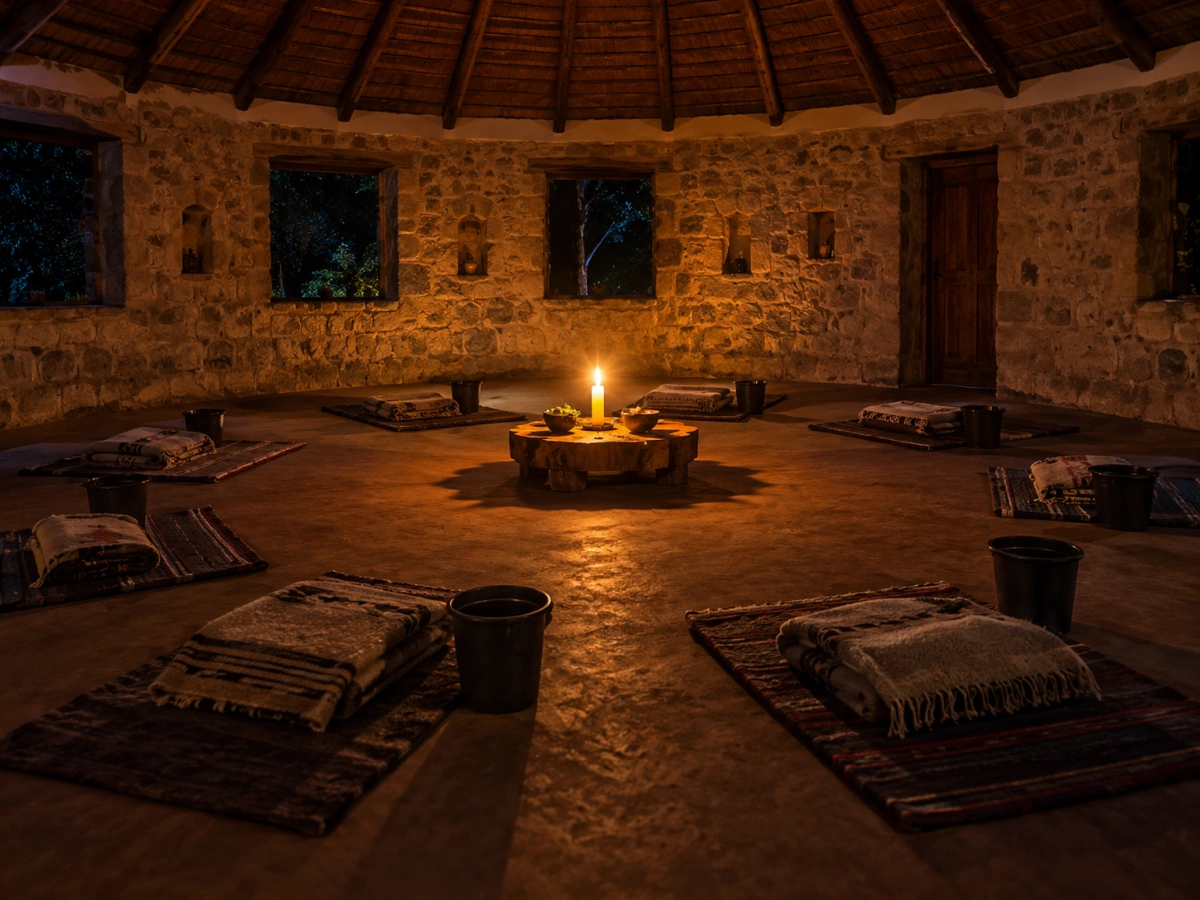
Ayahuasca visions mean less than almost anyone will tell you, and the research is blunt about it. The standard questionnaire psychedelic scientists use to predict who gets better contains 30 items. Not one asks what you saw. No snakes, no jaguars, no geometric patterns, no colors. The instrument that correlates with antidepressant response measures something else: whether your sense of self came apart, whether the experience felt significant, whether you could put it into words afterward. So when you sit down to decode a spider or a river, you are working on the part the evidence says least about. We have run roughly 700 ceremonies in 9 years. The guests who got better were not the ones with the best images.
What Do Ayahuasca Visions Mean?
Ayahuasca visions are the eyes-closed imagery that appears during a ceremony, usually 30 to 60 minutes after drinking. They range from geometric lattices and spirals to animals, people, memories and landscapes. Their content is shaped by your memory, culture and emotional state, so the same snake means different things to 2 different people. Meaning is assigned afterward, not delivered inside the vision.
That paragraph is the honest version. What follows is why it matters more than it sounds.
Why the Imagery Is Probably Not the Part That Matters
The imagery is not what the outcome research tracks. One scale keeps showing up as a predictor of clinical response: the Mystical Experience Questionnaire. Frederick Barrett, Matthew Johnson and Roland Griffiths revised it to 30 items in the Journal of Psychopharmacology in 2015. It has 4 factors: mystical, positive mood, transcendence of time and space, and ineffability.
Read all 30 items. Not one asks about visual content. The closest is an item about “pure being and pure awareness (beyond the world of sense impressions).” That describes the absence of imagery, not the presence of it.
| What the MEQ30 asks about | What it never asks about |
|---|---|
| Loss of boundary between self and surroundings | Animals, faces or beings you saw |
| Sense that the experience was sacred | Colors, brightness or saturation |
| Certainty of encountering ultimate reality | Geometric patterns, fractals, spirals |
| Time and space losing meaning | Landscapes, rooms, cities |
| Inability to describe it in words | Whether the imagery was pleasant |
| Feelings of peace, joy, awe | Symbolic content of any kind |
That was a design choice, not an oversight. The researchers split the perceptual effects from the ones carrying the therapeutic signal. The visions landed on the wrong side of that line.
Kwonmok Ko and colleagues at King’s College London reviewed 12 studies on this in Frontiers in Psychiatry in 2022. They found a steady link between mystical experience and outcome. They were careful about what they had not shown: correlation, prediction and mediation, yes, causation no. Six of the 12 studies were open-label. The measure itself is self-reported and cannot be observed from outside. So even the construct that does predict outcome sits on softer ground than most retreat pages admit. We’ve written before about how retreat sites quote research and the same caution applies here.
The 2 Things That Predict Whether You Get Better
Two things predict it: an emotional breakthrough during the session, and psychological insight in the days after. Joseph Peill, Robin Carhart-Harris and colleagues at Imperial College London validated the Psychological Insight Scale in the Journal of Psychopharmacology in 2022. They used 886 people at real ceremonies, not a lab.
The numbers are worth sitting with. Insight measured 1 day after the ceremony predicted wellbeing 2 weeks later at rs = 0.344 across 312 participants. Among the 120 people who started with low wellbeing, the group most retreats are selling to, that relationship nearly doubled to rs = 0.506. And the strongest path in the whole model was emotional breakthrough feeding insight, at a beta of 0.58.
Emotional breakthrough. Not imagery. The measure is about something releasing, not something appearing.
That finding should change how you prepare. Arrive set on seeing something and you are chasing the weakest variable in the research. Arrive willing to let something break and you are aiming at the one that carries the effect.
Don Julio Quispe Condori, who has worked with this medicine for 50 years and dieted more than 35 master plants, puts it without the statistics: “The vine is a teacher. You do not need to shout at a teacher to make them speak louder. You need to listen better.”
Why Geometric Patterns Show Up for Almost Everyone
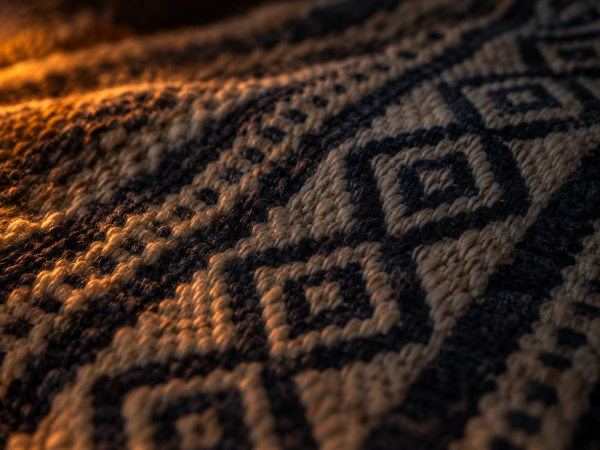
Geometric patterns appear because of how your visual cortex is wired, not because they carry a message. Heinrich Kluver catalogued them in the 1920s and found they fall into 4 repeating types: gratings and lattices and honeycombs; cobwebs; tunnels and funnels and cones; and spirals. He called them form constants because they show up across people, across substances, and even in migraine and pressure on the eyeball.
Paul Bressloff, Jack Cowan and colleagues explained why in the Philosophical Transactions of the Royal Society B in 2001. Their paper on the architecture of striate cortex showed these 4 shapes fall out of the math when you map V1 activity back onto the visual field. Circles in your visual field become vertical lines in the cortex. Rays become horizontal lines. Spirals become oblique lines. Destabilize the cortex and the patterns it produces, viewed from the outside, are Kluver’s form constants.
So the honeycomb is the shape of your own visual cortex under load. Reading it as a symbol is reading your hardware as a message.
That does not make it worthless. It means the geometry is the least personal part of what you saw, and the part least worth journaling about.
What Do Snakes and Jaguars Mean in Ayahuasca Visions?
Animals carry the meanings your own life has already assigned to them. There is no fixed dictionary, and every page that publishes one is selling you something. Certain animals do show up more in an ayahuasca ceremony than in, say, a psilocybin session in Baltimore. The imagery you have absorbed shapes the imagery you produce. That is cultural priming, not revelation.
| Common vision | Popular reading | What we’d say instead |
|---|---|---|
| Snake or serpent | Transformation, shedding the past | Ask what you associate with snakes. Fear and disgust are as common as reverence, and both are information |
| Jaguar | Power, protection, a guide | Note whether it approached or watched. The relationship matters more than the animal |
| Spider or web | Being trapped, entanglement | Usually points at a pattern of thinking, and the feeling in your body tells you which one |
| A dead relative | A visitation | Grief you have not finished. Treat it as your own material, not a message from outside |
| Geometric lattice | Sacred geometry, cosmic order | Visual cortex architecture. Interesting, rarely meaningful |
| Nothing at all | The medicine did not work | Common, and no reliable indicator of outcome. See below |
Notice the pattern in the right column. Every entry moves the question from what the image is to what it did to you. That’s the shift the outcome research supports.
Why Ayahuasca Visions Feel More Real Than Dreams
They feel real because ayahuasca increases connectivity in the brain regions that build your sense of a perceived world. Carla Soares, Miguel Castelo-Branco and colleagues published a crossover fMRI study in Social Cognitive and Affective Neuroscience on 31 January 2026. Twelve experienced participants received placebo, 0.5 mg/kg DMT, and 0.8 mg/kg DMT across separate sessions with 1 to 2 months between them.
At the higher dose the study found stronger connectivity in the third visual pathway and the mirror neuron network. The right posterior superior temporal sulcus coupled more tightly to visual cortex and to supplementary motor cortex. The strongest behavioral link was with perspective-taking, not with vividness.
A 2023 systematic review by Gattuso and colleagues in the International Journal of Neuropsychopharmacology adds the other half. Ayahuasca disrupts the default mode network during the acute experience, the network tied to self-referential thinking. It also increases coupling between that network and visual areas.
Put those together and the mechanism is readable. Your sense of self loosens while your visual and social-perception systems get louder and better wired. The result feels like meeting something rather than imagining it. But the same process makes both the feeling and the imagery. That is why a sense of significance is not evidence of significance.
What If You Did Not See Anything?
Seeing nothing is common and it predicts nothing. Plenty of first nights are quiet. In the only randomized placebo-controlled trial of ayahuasca for depression, run by Fernanda Palhano-Fontes and colleagues in Brazil and published in Psychological Medicine in 2019, 64% of the ayahuasca group responded at day 7 against 27% on placebo, in 29 patients. Which also means 36% of people who drank real ayahuasca did not respond. Nobody sorts those groups by what they saw, because nobody measured it.
Timing explains some quiet nights. A 2025 review by Rafael dos Santos and Jaime Hallak in CNS Spectrums put first effects at 30 to 60 minutes, the peak at 60 to 120 minutes, and resolution by 240 minutes. If you are lying there at minute 25 deciding nothing is happening, you are early. We go through this in more detail in our piece on the 3 clocks running during a ceremony.
Here’s what Don Julio says to guests who drink 2 nights running and feel nothing, translated from Quechua: “The vine is learning you. It does not always announce its arrival. Sometimes it walks through your house at night and rearranges the furniture so quietly you do not notice until morning. Pay attention to your dreams. The medicine is not absent. You are looking for it in the wrong room.”
Some of the strongest third and fourth nights we see follow 2 quiet ones.
Do Shamans Interpret Your Visions?
Ours do not, and we think the centers that advertise interpretation are describing the wrong job. Nearly every article on this topic says the shaman reads your visions and explains them. That’s a Western expectation projected onto a practice that works differently.
Don Julio trained for 12 years under Maestro Fernando Chujandama in San Martin. In that vegetalista tradition the healer’s work in ceremony is directed, not interpretive. The icaros are the instrument. He opens with protection songs, moves to diagnostic songs, then works guest by guest. He never asks what you are seeing. The picture is not what he is tracking.
There is one moment where he reads you, and it isn’t about visions. Before serving each guest he does something he calls hampi qhaway: about 30 seconds face to face, holding a coca leaf, whispering in Quechua, deciding your dose. It settles how much you drink, not what your snake meant. He has declined to serve a guest on a first night 3 times in 9 years. Twice those guests drank on a later night and had strong ceremonies.
If you want a symbol decoded, you will leave our maloca without one. What you get instead is 2 individual consultations during the retreat and a facilitator with 500-plus hours of ceremony behind him. You can read about the people in the room before deciding whether that trade suits you.
How Altitude Changes the Visions in 2026
Altitude changes the timing more than the content, at least in what we observe. Our maloca sits at 2,900 meters in the Sacred Valley, between Pisac and Ollantaytambo. Across 9 years and more than 700 ceremonies we have seen onset run 15 to 20 minutes later than the sea-level figures in the pharmacology literature, with a gentler peak that lasts longer. That is our observation across our own ceremonies, not a published finding, and we are not aware of a controlled study on highland ayahuasca. Treat it as what it is.
The brewing changes too, and that part is physics rather than opinion. Water boils at roughly 90 degrees Celsius at 2,900 meters instead of 100. The USDA puts the drop at a little under 1 degree Fahrenheit for every 500 feet of elevation, which works out to about 19 degrees Fahrenheit at our altitude. Don Julio spent his first 2 years here resetting cook time and reduction ratios around that. Since 2020 we have kept a written brew log. It now covers more than 120 batches: vine weight, chacruna weight, water volume, cook time, and his rating of the result.
The altitude also changes who can safely drink here, which is a screening question rather than a vision question. We cover the disqualifiers in our guide to what gets an application declined.
How to Work With a Vision Without Over-Reading It
Work with the feeling, not the picture. That’s the whole method, and it follows directly from the Peill finding that emotional breakthrough drives insight and insight predicts wellbeing.
Three questions do most of the work. Where did you feel it in your body? What did it ask you to stop doing? What would change on Monday if you took it seriously? None of them require you to know what a jaguar symbolizes.
The guests who improve here share a short list of behaviors. They keep a daily practice, usually journaling or meditation. They make at least 1 concrete change to their external life within 3 months. They stay connected to a therapist or the alumni group. And they accept that progress is not linear.
The ones who struggle share a different list. They expect the medicine to do the work. They go home to an unchanged environment. They isolate. Or they book another retreat instead of doing the work from the last one.
That is why our integration program runs 12 months instead of ending at the airport. A video call in week 1, a follow-up in week 3, then check-ins at months 2, 6 and 12, with surveys at 3 months. About 85% of guests take the week 1 call. By month 6 that drops to roughly 40%. That number is honest about how hard the follow-through is.
What We Track, and What We Do Not
We measure outcomes and we publish the unflattering half. Since 2020 every guest completes the PHQ-9 and PCL-5 at intake, on day 12, and again at 3 months. Across roughly 310 guests with complete 3-month data, average PHQ-9 scores went from 12.1 at intake to 6.4 on day 12, then held at 6.3 at 3 months. That is a 5.8-point drop. A 5-point change is the usual threshold for clinically meaningful. About 20% scored above the PTSD cutoff on the PCL-5 at intake. Their average fell from 46.8 to 34.2, and 65% dropped below the cutoff.
Now the part most centers leave out. 71% showed sustained improvement at 3 months, which means 29% did not. We do not know which 29% in advance, and we have never found a way to predict it from what anyone saw in ceremony.
This is observational data from people who chose to come here and chose to answer the surveys. It is not a clinical trial and we will not dress it up as one. The selection bias runs in our favor. We would rather say that than let you assume otherwise.
What we run is deliberately small: a maximum of 14 guests with 3 healers and 2 facilitators in the room, 4 ceremonies across 12 days rather than the 5 to 7 in a week that much of the industry sells. Don Julio’s reasoning: “If you drink every night, you are shouting at a river. If you leave space, the river speaks back.”
If you want to work out whether any of this fits your situation, applications are read by our physician and there is no charge to apply. The honest summary of ayahuasca visions meaning is that the pictures are the least useful part of the night, and what you do in the 12 weeks afterward decides almost everything.
Frequently Asked Questions
What do ayahuasca visions mean?
They mean what your own history makes them mean. There is no universal dictionary, and the questionnaire that predicts clinical improvement after a psychedelic session, the 30-item MEQ30, contains no questions about visual content at all. Meaning gets assigned after the ceremony, during integration, not delivered during it.
Do ayahuasca symbols have universal meanings?
No. Geometric patterns are the exception, and only because they come from shared anatomy rather than shared meaning. Kluver’s 4 form constants show up across people and across substances because of how the visual cortex maps onto the visual field, as Bressloff and colleagues showed in 2001. Everything else, animals included, is filtered through your culture, memory and mood.
What does seeing a snake in an ayahuasca vision mean?
Whatever snakes already mean to you. Snakes turn up often in Amazonian ceremonies partly because snake imagery fills the tradition’s art and stories, which primes what your brain produces. The useful question is not what the snake represents. It is what happened in your body when it appeared, and whether it came to you or you went to it.
Why did I not see anything during my ayahuasca ceremony?
Quiet nights are common and predict nothing about outcome. Effects typically begin 30 to 60 minutes after drinking and peak between 60 and 120 minutes, so people often conclude nothing is happening while still inside the onset window. In the only randomized controlled trial of ayahuasca for depression, 36% of people who drank the real thing did not respond at all, and no study has ever sorted responders by what they saw.
Do shamans tell you what your ayahuasca visions mean?
Some centers advertise it. In the vegetalista tradition our healers work in, the work is directed rather than interpretive. The icaros are the instrument, and the healer tracks your state rather than your imagery. Our lead healer reads each guest for about 30 seconds with a coca leaf before serving, but that sets the dose, not the symbolism.
Does the meaning of ayahuasca visions last?
The sense of significance fades faster than most people expect, which is why integration matters more than interpretation. In the 2022 Imperial College study, insight measured 1 day after a ceremony predicted wellbeing 2 weeks later at rs = 0.344 across 312 participants. Among those who started with low wellbeing it rose to rs = 0.506. In our own 3-month data across roughly 310 guests, 71% showed sustained improvement and 29% did not. The meaning of ayahuasca visions is decided in that window, not in the maloca.
Does altitude change ayahuasca visions?
We observe that it changes the timing. At 2,900 meters we see onset run 15 to 20 minutes later than published sea-level figures, with a gentler and longer peak. That is our observation across more than 700 ceremonies rather than a controlled finding, and no published study has compared highland and lowland ceremonies directly. Altitude does change our medical screening, because reduced oxygen adds cardiac and pulmonary contraindications. On ayahuasca visions meaning, altitude changes when the imagery arrives, not what it is worth.
Medical disclaimer: this article is for information only and is not medical advice. Ayahuasca is not a treatment for any condition. It carries real risks, including dangerous interactions with prescription medication. Speak to your own doctor before making any decision about your health or medication.