Physical Preparation For An Ayahuasca Retreat: What Changes At 2,900 Metres
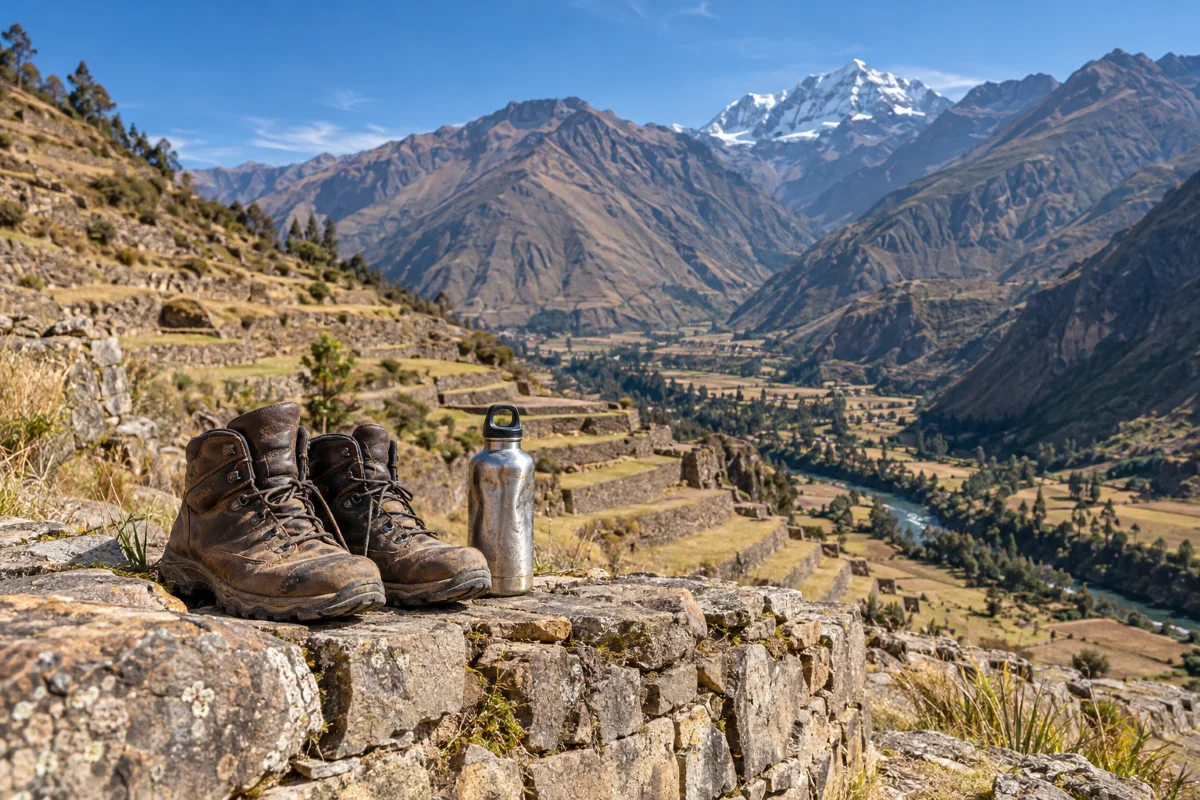
Physical preparation for an ayahuasca retreat is food rules on almost every site you’ll read, and that’s the wrong order. If your ceremony sits in the Andes, 3 other things decide your first night: the speed of your ascent, your caffeine timing, and the 48 hours after you land. We run our centre at 2,900 metres in the Sacred Valley. Across 9 years and roughly 2,000 guests, the most common preparation mistake we see is simpler than a broken diet: a body that lands at altitude with no time to adjust. Here is what to do with yours, and what we got wrong ourselves.
What is physical preparation for an ayahuasca retreat?
It’s the work you do on your body before you drink, and at altitude it starts earlier than the food rules do.
Physical preparation for an ayahuasca retreat is the work you do on your body in the weeks before you drink: simplifying food, clearing alcohol and drugs, protecting sleep, and reaching the altitude early enough to adjust. At a highland centre it also means cardiopulmonary screening, a planned caffeine taper, and mild activity only for the first 2 days.
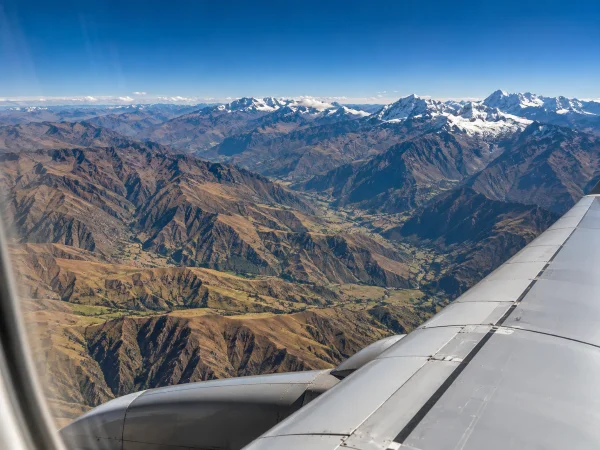
The numbers behind that last part are worth seeing before anything else. A 2023 systematic review in the Journal of Travel Medicine pooled 12 studies and 11,021 people across 19 high-altitude destinations. It found a 4.5-fold steeper rise in acute mountain sickness for every 100 metres gained when people arrived by air instead of on foot: 11.5% per 100 metres by air against 2.1% on foot. Flying to 3,350 metres, which is Cusco, produced acute mountain sickness in 39% of travellers.
Guests fly in rather than walking up, and that one fact outranks the diet.
Should you get fit before an ayahuasca retreat?
No, and we were wrong about this in our own preparation guide.
The CDC Yellow Book puts it in 8 words: “Training and physical fitness do not affect risk.” That means the risk of altitude illness. It begins at a sleeping elevation of 2,450 metres (8,000 feet) for anyone who has not adjusted. Our centre sits above that. So does Cusco, by 900 metres.
Our guide used to tell guests to start light cardiovascular work 2 to 3 weeks out to improve altitude tolerance. The advice was harmless. The reason we gave for it was wrong, and on a page about your body that distinction matters. Walking, swimming and easy cycling are good for you and they will not protect you here.
What does protect you is the opposite of training hard. The CDC’s instruction for the first 2 days is plain: participate in only mild exercise for the first 48 hours at altitude. A fit guest who lands in Cusco and spends day 1 climbing to Sacsayhuaman does the one thing the guidance says to avoid. Feeling capable is what tempts them into it.
So the rule we send now: keep moving, don’t peak, and treat your first 2 days in Peru as rest days you booked on purpose.
The physical preparation timeline we send guests in 2026
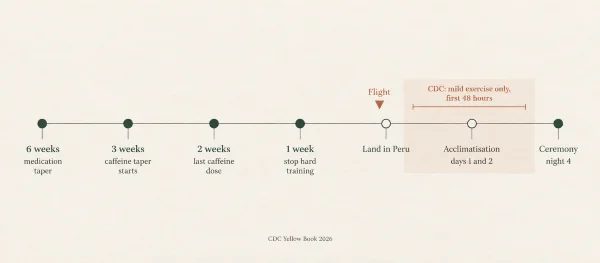
Preparation runs on a schedule. Here’s ours, working backwards from night 4 of the 12-day format, when the first ceremony happens.
| When | What your body is doing |
|---|---|
| 6 weeks out | Any supervised medication taper begins. Dr. Medina and your own prescriber agree the plan |
| 3 weeks out | Caffeine taper starts if you drink 2 cups a day or more. The next section explains why this moves earlier than most guides say |
| 2 weeks out | Last caffeine dose, which puts it at least 7 days before you fly. Food simplifies. Alcohol and cannabis stop. Sexual abstinence begins |
| 1 week out | No hard training. No personal bests. Sleep becomes the priority |
| 2 days out | Land in Peru. We can book you into the Sacred Valley at about 2,600 metres rather than the city at 3,350 |
| Retreat days 1 to 2 | Acclimatisation. Mild walking only. Oxygen saturation checked. No ceremony |
| Retreat night 4 | First of 4 ceremonies, on nights 4, 6, 9 and 11 |
The caffeine date and the acclimatisation days are the 2 rows no other preparation page carries. Both came from mistakes. In 2017 guests arrived and drank on the second night, and that year 3 of them developed moderate altitude sickness. In 2018 we rebuilt the format from 10 days to 12 and put 2 full rest days in front of the first ceremony.
When should you stop caffeine before an ayahuasca retreat?
At least 7 full days before you fly, not 7 days before the retreat starts. Most guides, ours included until now, give the second version, and it creates a problem nobody writes about.
Start with how altitude illness gets diagnosed. The CDC names headache as the cardinal symptom, usually with at least 1 of loss of appetite, dizziness, fatigue, nausea or occasionally vomiting. Onset is 2 to 12 hours after you arrive, often during or after the first night. The 2018 Lake Louise criteria, used in altitude research, won’t score a case without one.
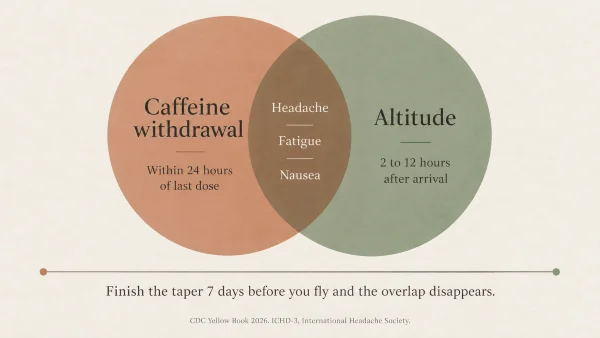
Now read the other list. The International Classification of Headache Disorders, 3rd edition, defines caffeine-withdrawal headache as one that follows intake above 200 milligrams a day for more than 2 weeks that is then interrupted. It develops within 24 hours of the last dose and clears within 7 days if you stay off it. 200 milligrams is about 2 cups of coffee.
Put the two together and the problem shows up. A guest quits coffee on Tuesday, flies on Thursday, and wakes in Cusco with a headache, fatigue and nausea nobody can explain.
| What you feel | Caffeine withdrawal | Altitude |
|---|---|---|
| Headache | Yes, within 24 hours of the last dose | Yes, 2 to 12 hours after arrival |
| Fatigue | Yes | Yes |
| Nausea | Yes | Yes |
| Clears when | Within 7 days off caffeine | 12 to 48 hours if you don’t go higher |
| What fixes it | Time, or 100 mg of caffeine | Rest, fluids, descent if it worsens |
The two overlap almost completely. The difference is timing, which is why the fix is a calendar rather than willpower. Finish the taper a week before the flight and the withdrawal is over before you leave home. Then anything you feel in Cusco is information your body is giving you about the altitude, and we can act on it.
Taper rather than stopping cold, and tell us what you were drinking. It changes what your day 1 headache means.
What to eat in the last week
Eat plainly, and in smaller amounts than you think. The full list of restricted foods sits in the full preparation countdown, with the reason behind each one. Here is only the part about your body at altitude.
Appetite drops when you arrive. The CDC lists loss of appetite among the symptoms of altitude illness, and plenty of guests who never develop altitude sickness still eat less for 2 days. Ana Maria runs our kitchen around that: quinoa porridge, soups, trout, potatoes, fruit. Nothing heavy, nothing fried, nothing that asks much of your stomach.
On ceremony days you eat fruit and quinoa for breakfast and a final meal at 4pm of plain quinoa, boiled potatoes and simple vegetables, with no salt and no spice. No dinner. That’s about 5 hours of empty stomach before you drink, not a fast. Don’t invent a longer one. Arriving at a ceremony underfed at 2,900 metres gets you lightheaded, not pure.
Water, sleep and the 48 hours after you land
Drink to thirst and protect your sleep harder than your diet. Sleep is the first thing altitude takes, and it’s the thing most guests sacrifice to a red-eye flight.
Alcohol is the clearest line. The CDC says avoid it for the first 48 hours at altitude, and that respiratory depressants like alcohol and opiates should not be used to help you sleep up here. Our dieta has already removed alcohol 2 weeks out, so by the time you land the question is closed.
On water: steady is better than heroic. Thirst runs high at altitude and the air is dry, so most people need more than at home. Nobody has shown that drinking extra prevents altitude illness, and we don’t claim it does. That’s an observation from 9 years of watching guests, not a finding.
What altitude and ayahuasca both ask of your heart
Your heart needs screening, not training. Ayahuasca nudges the cardiovascular system upward, and altitude has already done the same thing before you drink.
A systematic review in the Brazilian Journal of Psychiatry gathered what the human studies show. Riba and colleagues in 2003 measured increased diastolic blood pressure and moderate heart rate rises after ayahuasca. Dos Santos and colleagues in 2011 found the effects peaking around 2 hours and back to baseline by 24. A review of 538 poison centre reports found tachycardia in 34% of cases and hypertension in 16%.
None of that is alarming in a screened, healthy person at sea level. At 2,900 metres, with a resting heart rate already raised by acclimatisation, it’s the reason our cardiac screening is stricter than a jungle centre’s. Every guest over 45 does an ECG. That rule came from a 2022 incident, not a textbook.
The CDC also lists conditions that rule out high-altitude travel. Sickle cell anaemia, severe COPD, pulmonary hypertension above 60 mm Hg systolic, decompensated heart failure, and a heart attack or stroke in the previous 90 days. Some of those are fine for a lowland retreat and not for ours, which is why conditions that rule ayahuasca out is a longer list here. We decline 13% of applicants outright, and Dr. Medina reads every application before anyone pays.
Can you take Diamox before an ayahuasca ceremony?
Not without talking to the retreat’s physician first, and at our centre it stops before the first ceremony.
Acetazolamide, sold as Diamox, is the standard altitude drug. The CDC’s prevention dose is 125 mg every 12 hours, starting the day before you go up and continuing the first 2 days. Plenty of travellers pack it for Cusco without a second thought.
Here’s the part no other preparation guide mentions. Ayahuasca contains reversible inhibitors of monoamine oxidase A. Any drug a guest brings to Peru has to be looked at against that, and acetazolamide is a drug, not a supplement. Dr. Medina decides case by case whether a guest uses it during acclimatisation, and it is discontinued before ceremony. Tell us if it’s in your bag.
The same goes for a thing you won’t think of. There’s no malaria risk at 2,900 metres, so nobody here takes antimalarials. At jungle centres they become another drug the retreat has to screen. It’s one of the few ways altitude makes preparation simpler.
Coca tea is the other question everyone asks. We serve it daily and guests like what it does for their stomach. Caravedo and colleagues followed 142 travellers through their first 48 hours in Cusco. That’s the cohort behind the 39% figure above. Their 2022 paper in the Journal of Travel Medicine found coca leaf tea drunk for prevention did not lower the risk. Acetazolamide did. Drink the tea because you like it, not because it’s protecting you.
What to pack so your body copes with the cold
Warm layers, more than you expect, and a headlamp with a red setting.
Ceremony nights here run between 2 and 10 degrees Celsius. You’ll be lying still on a mat for 6 hours or more, which is how a ceremony that long turns cold into a physical problem rather than a comfort one. We provide alpaca blankets and the cabanas have wood stoves. Bring thermal underwear, wool socks, a down jacket and a hat anyway.
The rest of the body list: hiking boots for stone terraces, electrolyte sachets, lip balm and moisturiser for dry air. Bring sunscreen too. UV at this elevation burns people on overcast days.
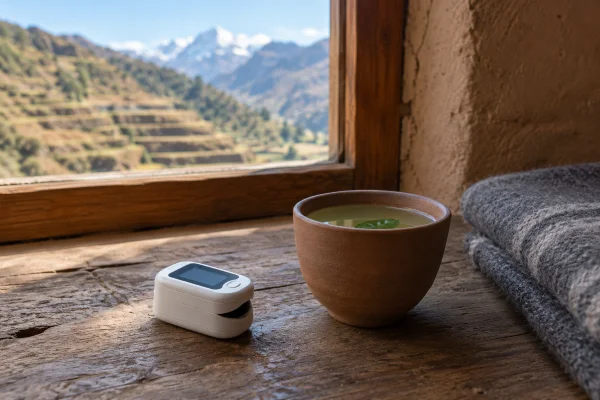
What happens during your 2 acclimatisation days
We watch your body and you do almost nothing, which is the point.
Oxygen saturation gets checked during those first days. We keep 3 pulse oximeters, 2 portable oxygen cylinders, acetazolamide, dexamethasone and a Gamow bag on site, and Dr. Medina trained in altitude medicine at the Instituto de Investigaciones de Altura in La Paz. Across roughly 2,000 guests, 10 to 12 have needed supplemental oxygen during acclimatisation. All of them were managed on site.
That’s a small number, and it’s the honest one. Most people adjust. The 2 days exist for the minority who don’t. For everyone else, they mean the first ceremony meets a body that has settled rather than one still catching up.
Physical preparation for an ayahuasca retreat is simpler than the internet makes it and better sequenced than most guides suggest. Start the caffeine taper 3 weeks out and take the last dose at 2. Eat plainly for the final fortnight. Stop training hard in the last week. Land early, move slowly for 48 hours, and tell the truth about what’s in your bag. If you want our physician to look at your history before you book anything, send us your medical details and he reads it before any money changes hands.
FAQ
What is physical preparation for an ayahuasca retreat?
It’s the work you do on your body in the weeks before you drink: simplifying food, clearing alcohol and drugs, protecting sleep, and reaching the altitude early enough to adjust. At a centre above 2,450 metres it also covers cardiopulmonary screening and a planned caffeine taper. The food rules get the attention. At altitude, the timing of your arrival matters more.
Should you exercise before an ayahuasca retreat?
Light activity is fine and hard training in the final week is not. The CDC Yellow Book states that training and physical fitness do not affect the risk of altitude illness, and it tells travellers to take only mild exercise for the first 48 hours at altitude. Being fit will not protect you at 2,900 metres, and feeling fit is what tempts people to overdo their first 2 days.
When does physical preparation for an ayahuasca retreat start?
6 weeks out if you take any medication that needs a supervised taper. 3 weeks out for the caffeine taper, 2 weeks for the food changes, alcohol and cannabis. If you take nothing, 3 weeks gives you enough room without rushing.
When should you stop caffeine before an ayahuasca retreat?
Take your last dose at least 7 full days before you fly. The International Classification of Headache Disorders defines caffeine-withdrawal headache as following intake above 200 milligrams a day, about 2 cups of coffee, for more than 2 weeks, developing within 24 hours of the last dose and clearing within 7 days. Headache is also the cardinal symptom of altitude illness, so quitting 2 days before a flight to Cusco produces a headache nobody can attribute.
Does being fit protect you from altitude sickness in Cusco?
No. A 2023 systematic review in the Journal of Travel Medicine covering 11,021 people found that arriving by air produces a 4.5-fold steeper rise in acute mountain sickness per 100 metres gained than arriving on foot, and that 39% of travellers flying to 3,350 metres developed it. What protects you is a slower ascent profile and rest in the first 48 hours, not your fitness level.
Can you take Diamox at an ayahuasca retreat?
Only with the retreat physician’s agreement, and at our centre acetazolamide is discontinued before the first ceremony. Ayahuasca contains reversible inhibitors of monoamine oxidase A, so every drug a guest brings gets reviewed against that, acetazolamide included. Tell the retreat before you travel rather than after you land.
Does coca tea help you prepare for a ceremony at altitude?
Not in the way most visitors assume. Caravedo and colleagues followed 142 travellers through their first 48 hours in Cusco and reported in the Journal of Travel Medicine in 2022 that coca leaf tea drunk for prevention did not lower the risk of altitude sickness. Acetazolamide did. We serve coca tea daily because guests find it settles the stomach, not because it protects them.