What Does Ayahuasca Taste Like? The 2 Bitter Cups We Pour
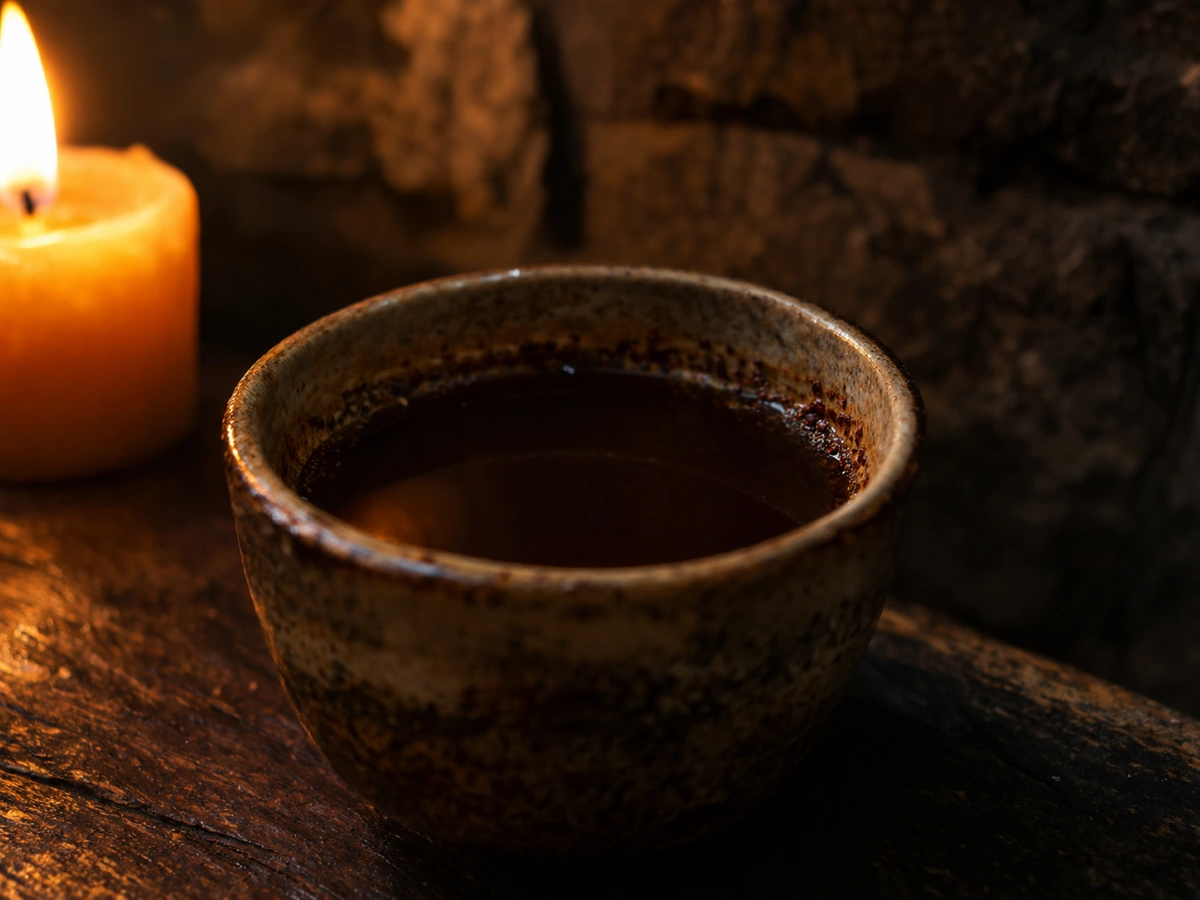
Ayahuasca tastes bitter first, then earthy, and it coats your mouth on the way down. Most guests reach for the same words: soil, wet bark, black coffee left overnight, molasses with the sweetness taken out. It is thick rather than watery, and there is grit at the bottom of the cup. Here is the part the other pages skip. That bitterness is not a test of your commitment. It is chemistry, and the reason it registers as bitter is that bitterness is the sense humans use to detect alkaloids. The brew is made of alkaloids. Your tongue is working correctly.
We are in an unusual position to describe it, because we pour 2 bitter cups in the same week. Ayahuasca at night, in the dark. San Pedro at 7:00 am, outdoors. Same 12 guests, 4 days apart. Almost nobody can compare those 2 flavours from direct experience, so most pages describe ayahuasca against nothing.
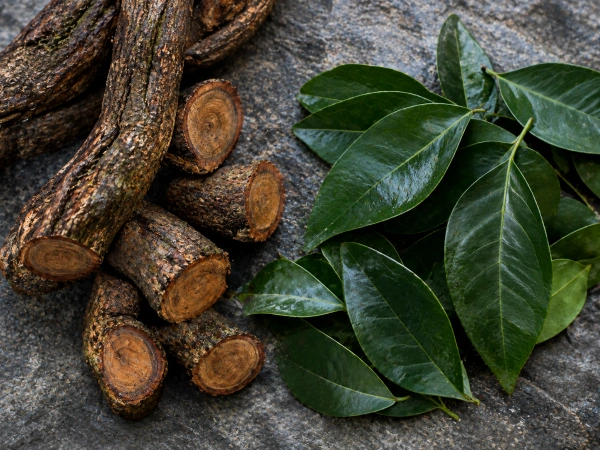
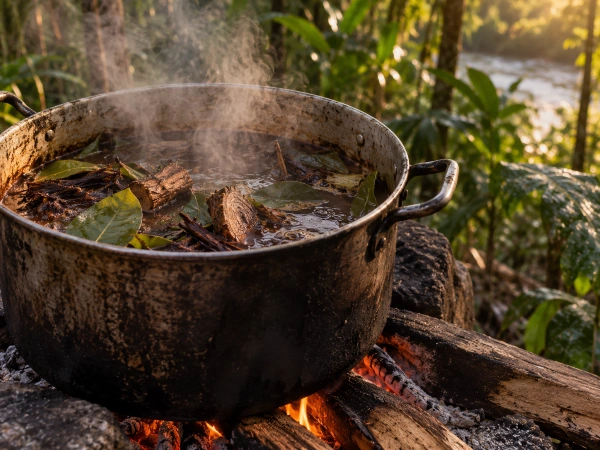
Ayahuasca is a brew of the Banisteriopsis caapi vine and chacruna leaf, boiled down for hours until it reduces to a dark, syrupy liquid. The taste is bitter and earthy with a long aftertaste, and the texture is thick and slightly gritty. Batches differ in strength and flavour because the plants, the water and the cook all differ.
Why is the brew bitter?
It is bitter because it is an alkaloid solution, and bitterness is how your body flags alkaloids. The 2024 systematic review of ayahuasca and DMT adverse events in the International Journal of Toxicology, by White and colleagues, names the brew’s main psychoactive compounds across 78 relevant articles: dimethyltryptamine, harmine, harmaline and tetrahydroharmine. The last 3 are harmala alkaloids, and they come from the vine.
Now the other half. The NIH’s StatPearls physiology reference states plainly that bitter tastes are due to alkaloids, and that bitterness “may denote a harmful or poisonous substance, and thus, would make one consciously aware and may prevent ingestion.”
Read those 2 facts together and the flavour stops being mysterious. Bitter taste evolved as a warning system for plant alkaloids. You are drinking a concentrated plant alkaloid solution. The recoil is the system doing its job, not a spiritual shortcoming.
We think that matters for how you prepare. Every other page on this topic asks you to reframe the taste as something sacred to be honoured. We would rather you knew what was happening in your mouth, because people who understand a sensation tolerate it better than people who have been told to revere it.
What does the texture feel like?
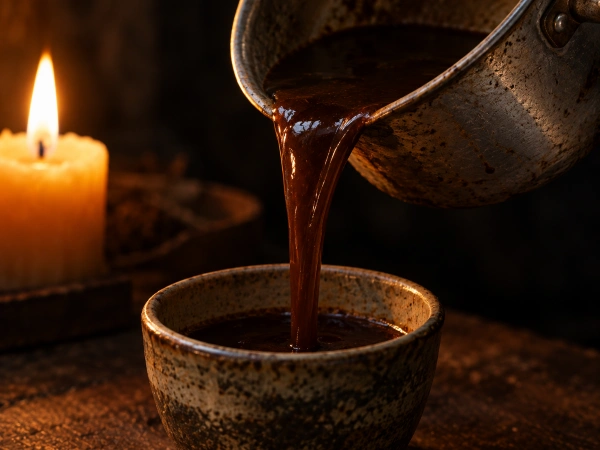
Thick, closer to cold syrup than to tea, with grit at the bottom of the cup. The thickness catches more guests off guard than the bitterness does. Nobody arrives expecting the brew to be pleasant. Plenty arrive expecting a tea.
It is not a tea. Hours of reduction leave a liquid closer to cold syrup, and fine plant matter settles out, so the last mouthful is heavier and grittier than the first. Guests describe the coating sensation more often than the flavour itself: it stays on the roof of the mouth and the back of the throat after the cup is gone.
The smell arrives before any of it. Cold, dark, vegetal, a little sour. Several guests have told us the smell was harder than the taste, because you get it while you are still standing in the queue with nothing to do but wait.
2 bitter cups, 4 days apart
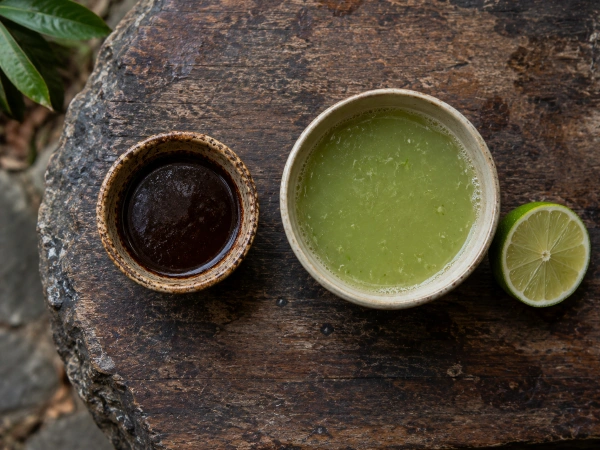
Both cups are bitter, and they are not bitter in the same way. This is the comparison we can make and a jungle centre serving one medicine cannot.
| Ayahuasca | San Pedro (huachuma) | |
|---|---|---|
| When you drink | Night, in a dark room | 7:00 am, outdoors on the terraces |
| Colour | Dark brown to near black | Green |
| Flavour | Bitter, earthy, wet bark and soil | Bitter, vegetal, closer to raw cucumber skin and grass |
| Texture | Thick, syrupy, grit at the bottom | Thick, pulpy |
| Volume | A small cup, poured by the maestro | A larger cup, sometimes a second smaller one around 10:00 am |
| Where it was made | Cooked in the lowlands and carried up | Cut within 40 minutes of the house, boiled on site the day before |
| After the cup | Water, and time in the dark | Lime, and 12 to 13 hours on your feet in daylight |
| Purging | Common, through the night | Roughly half of guests purge once, in the first 2 hours |
Guests who drink both almost always report the same thing: they expected the daytime cup to be the easier one, and the green cup is the one that surprised them. You can read the full shape of a San Pedro day hour by hour if that is the cup you are weighing.
Why our brew is not cooked in Cusco
Because the plants do not grow at this elevation, and because you cannot properly reduce a brew up here. Both halves of that are worth saying out loud, since most centres are vague about where the medicine came from.
The caapi vine and chacruna are lowland tropical plants. They do not grow at 11,150 feet. So our brew is cooked in the lowlands by the maestros’ own families and carried up to Cusco. The San Pedro is the opposite: it grows on these slopes, our huachumero cuts it himself, and it is sliced and boiled here in an open pot for about 12 hours the day before you drink it. We can tell you which cut yours came from. We cannot say that about the ayahuasca, and we say so rather than implying otherwise.
There is a physics reason too. The USDA’s guidance on high-altitude cooking states that the boiling point drops by just under 1 degree Fahrenheit for every 500 feet of elevation. At 11,150 feet water boils near 192 degrees Fahrenheit instead of 212. A cook that depends on hours of hard boiling to reduce and concentrate does not behave the same way 20 degrees cooler. The lowlands are where that cook works.
Does every batch taste the same?
No, and any centre telling you otherwise is not paying attention. The vine varies by age and by where it grew. The leaf-to-vine ratio varies. Water varies. Cook time varies. Reduction varies with the pot and the fire.
That shows up as real differences in the cup. Some batches read sweeter, almost like dark molasses. Others read like nothing but soil. The maestros taste every batch before it is served, and that taste is a working judgment about strength, not a ritual. A cook that came out wrong does not get poured.
Here is a belief worth dropping before you arrive: a sweeter-tasting cup is not a weaker cup. Sweetness and strength are not the same variable, and guests who treat a palatable batch as a mild one are reasoning from flavour to potency with nothing connecting the 2.
What we will not put in the cup
Nothing. No sugar, no honey, no juice, no mint.
That is not purity theatre, and it is not about making you suffer. Anything you add is another substance going into a brew that already contains monoamine oxidase inhibitors. The 2024 toxicology review is direct about this: harmala alkaloid risk rises when other compounds are co-administered. The list of things that interact badly with an MAOI is long and includes food. A maestro who has spent decades calibrating what goes into a cup is not going to let a guest drop something into it at the last second, and neither is our physician.
Water afterward, yes. Lime after the San Pedro cup, yes. Into the cup, nothing. The same logic runs through our whole medication and screening process, which is stricter than most because a physician rather than a salesperson decides who drinks.
The taste, the purge, and what actually settles it
The taste contributes to nausea, but it is not the reason people purge. Purging is common with or without a bad flavour in your mouth.
The scale is worth knowing before your first night. The same 2024 review cites an epidemiological survey of 10,836 ayahuasca drinkers in which 69.9% reported vomiting or nausea, and 2.3% said they later needed medical attention. So roughly 7 in 10 have a physically rough time at some point. That is the baseline, not a sign something went wrong.
What guests tell us does change is the anticipation. By the 3rd and 4th ceremony most people report the cup itself bothering them less, while a smaller group finds it harder each night as the body learns what follows. Both patterns are normal and neither predicts anything about how the night goes. If you want the timings rather than the flavours, we lay out how long a ceremony runs separately.
What happens at the cup in 2026
You walk up, the maestro pours, and you drink it in one go. That is the whole procedure, and it takes about 4 seconds.
A few details people ask about beforehand. The dose is set by the maestro from your body weight and from what he has seen of you that week, not from what you ask for. A second smaller cup is sometimes offered later in the night, and declining it is a complete sentence. There is water afterward. Nobody films you, nobody comments, and in a dark room with 11 other people you are not the centre of attention.
Do not hold it in your mouth. The advice to savour the cup as a rite of passage circulates widely and we disagree with it. Bitterness lingers longer the more contact it gets. Swallow it, take the water, and let the night start.
Eat lightly and early on ceremony day, and follow the preparation guidance you are sent rather than improvising. An empty, settled stomach does more for how the cup sits than any trick with the taste.
So, what does ayahuasca taste like? Bitter, earthy, thick, with a finish that stays. It is 4 seconds of your night, and it is the least significant thing that will happen to you before morning. If that is the part you are stuck on, ask us before you apply rather than reading another page about it, and if you want to see what the week is built around instead, what the 7 nights involve is set out in full.
Frequently asked questions
What does ayahuasca taste like?
Bitter and earthy, with a thick, slightly gritty texture and a long aftertaste. Common comparisons are wet bark, soil, overnight coffee and unsweetened molasses. Batches vary, so 2 guests on 2 different nights can describe it differently and both be accurate.
Why does ayahuasca taste so bitter?
Because it is a concentrated alkaloid solution. The brew’s main active compounds are dimethyltryptamine plus the harmala alkaloids harmine, harmaline and tetrahydroharmine. NIH StatPearls states that bitter tastes are due to alkaloids, and that bitterness functions as a warning for potentially harmful substances. The recoil is your taste system working as designed.
Can you add anything to ayahuasca to make it taste better?
No. Anything added is another compound entering a brew that contains monoamine oxidase inhibitors, and the 2024 International Journal of Toxicology review notes that harmala alkaloid risk rises with co-administration. We serve water afterward and nothing in the cup.
Does the taste make you vomit?
It contributes, but it is not the main cause. In an epidemiological survey of 10,836 ayahuasca drinkers cited in that 2024 review, 69.9% reported vomiting or nausea and 2.3% later needed medical attention. Purging is common regardless of how the cup tasted.
How does ayahuasca taste compared to San Pedro?
Both are bitter and thick, in different registers. Ayahuasca is dark, earthy and reads like wet bark and soil. San Pedro is green, vegetal and closer to raw cucumber skin and grass. We serve both in the same 7 nights, and guests who expect the daytime cup to be gentler are usually the ones it surprises.
Does a sweeter batch mean weaker medicine?
No. Flavour and strength are separate variables. Some batches read almost like molasses and others like pure soil, and neither tells you how strong the cup is. The maestros taste every batch to judge that, and a cook that came out wrong is not poured.
How long does the taste stay in your mouth?
The sharp bitterness fades within a few minutes. The coating sensation on the palate and throat lasts longer, often until the medicine takes effect 30 to 60 minutes later, at which point almost nobody is still thinking about it.