Ayahuasca Safety: The Altitude Rules Nobody Publishes
Ayahuasca safety rests on 3 things: your medication list, your medical and psychiatric history, and whether the center can afford to reject you. Most retreat websites cover the first 2 and quietly skip the third. And almost none of them mention altitude, which changes the screening list before anyone pours a cup.
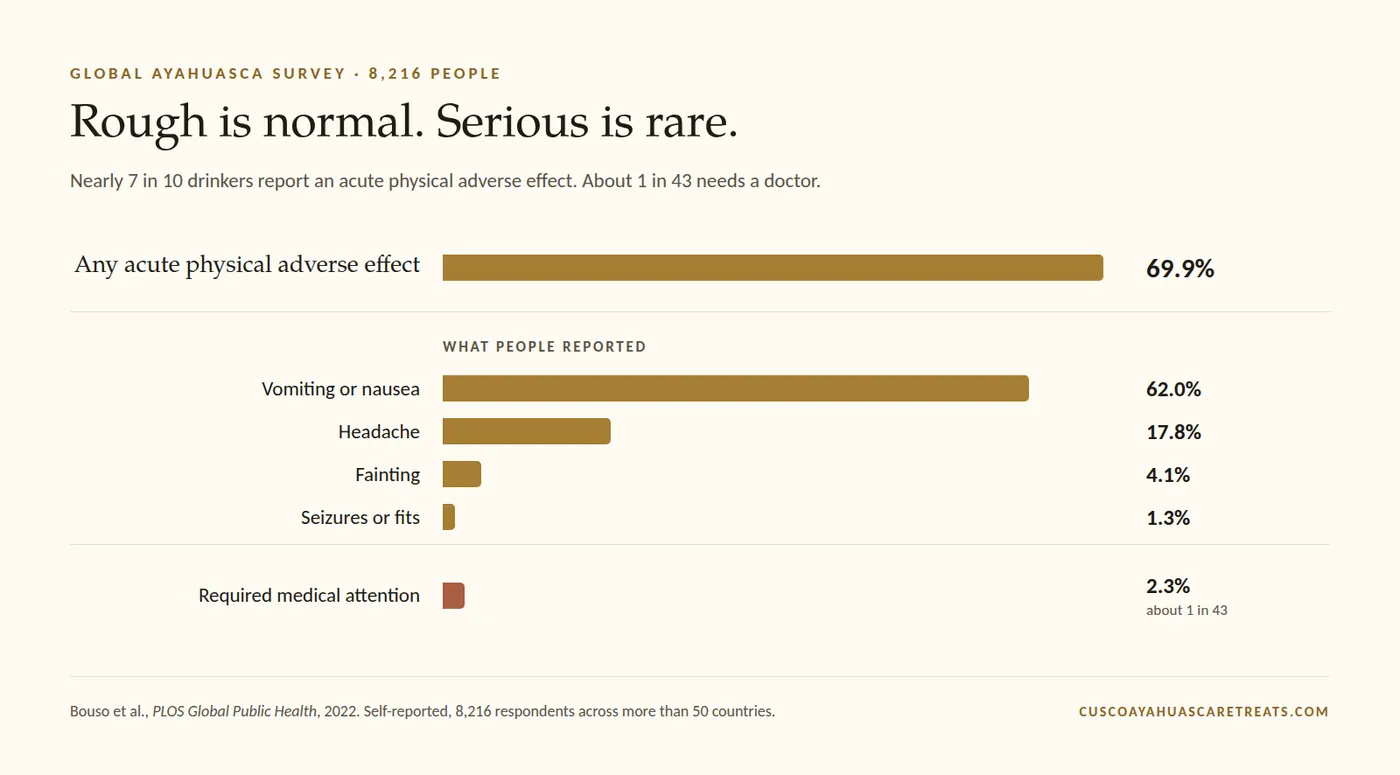
Here are the numbers. The largest survey of ayahuasca drinkers published to date, 8,216 people across more than 50 countries, found that 69.9% had an acute physical adverse effect and 2.3% required medical attention. So the honest summary is not “ayahuasca is safe” or “ayahuasca is dangerous.” Nearly 7 in 10 people have a rough physical time, and about 1 in 43 needs a doctor. What separates those groups is mostly screening.
What is ayahuasca safety? Ayahuasca safety is the set of medical screening, medication washout, and emergency protocols that decide who can drink the brew safely. It covers drug interactions with the MAOIs in the vine, psychiatric and cardiac exclusions, supervision during ceremony, and, at high altitude, a second list of conditions that lowland centers never check.
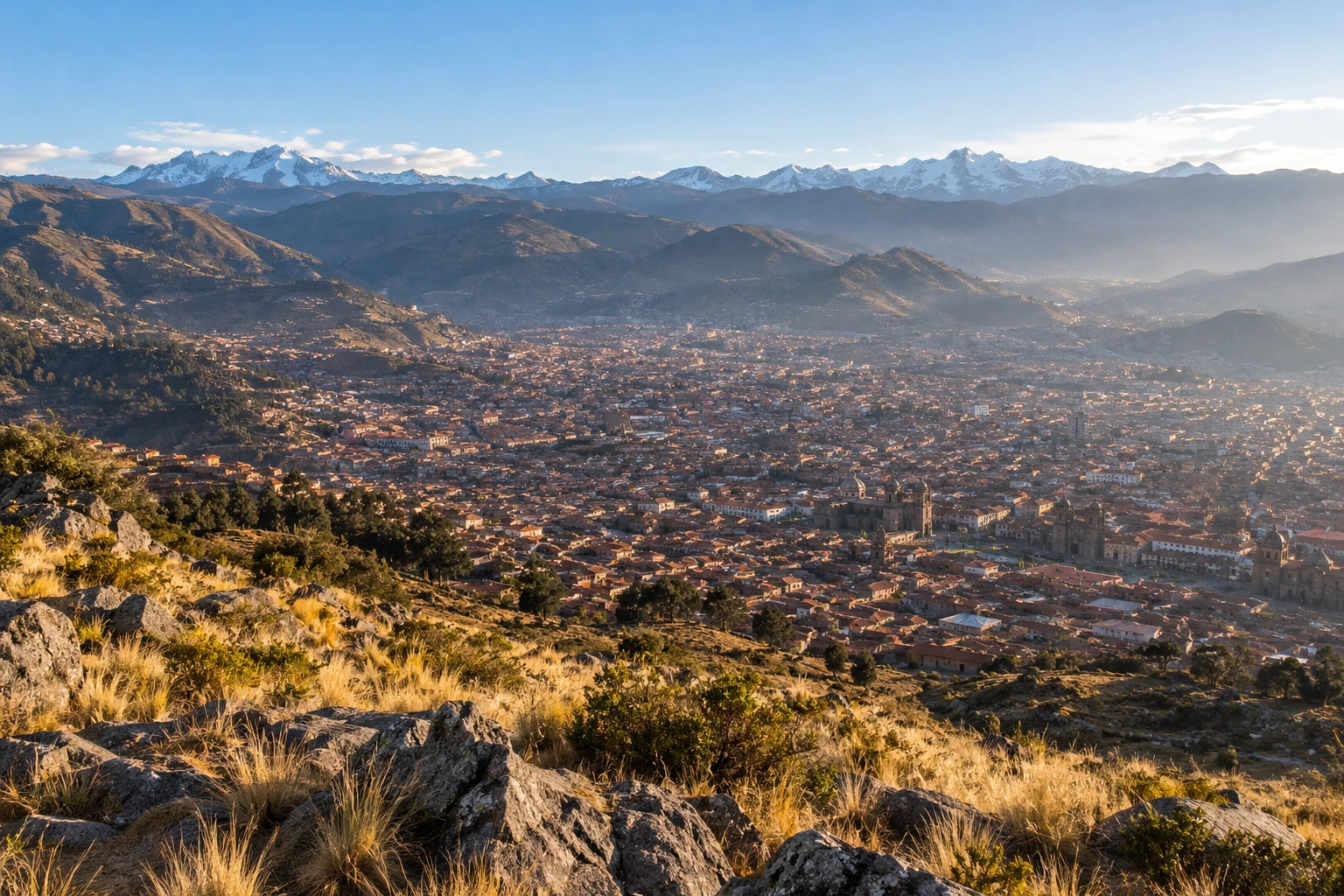
We run at 11,150 feet in Cusco. That elevation adds a screening layer most retreat pages have never had to think about, so this guide covers both lists: the standard one, and the one that only applies above about 8,000 feet.
What the Data Actually Says About Ayahuasca Safety
Physical side effects are the norm, not the exception, and serious events are rare. In that same Global Ayahuasca Survey, published in PLOS Global Public Health in 2022 by Bouso and colleagues, vomiting or nausea hit 62.0% of drinkers, headache 17.8%, fainting 4.1%, and seizures or fits 1.3%. Only 2.3% needed medical attention.
The mental side is messier and more interesting. 55.4% reported some adverse mental health effect in the weeks or months after drinking. But 87.6% of that group framed the experience as part of positive growth, and 11.9% went and got professional support. Adverse is not the same as damaging.
A 2025 reanalysis of the same cohort by Andion and colleagues in PLOS Mental Health, covering 5,400 respondents, found 2 things worth acting on. Non-traditional settings predicted worse after-effects across most measures. And extreme fear during the ceremony itself was the single strongest predictor of every negative state afterward. That is a research finding pointing straight at the room you drink in and the people in it.
So when someone asks whether ayahuasca is safe, the useful answer is a question back: safe with whom, screened how, and how far from a hospital?
Who Should Avoid Ayahuasca?
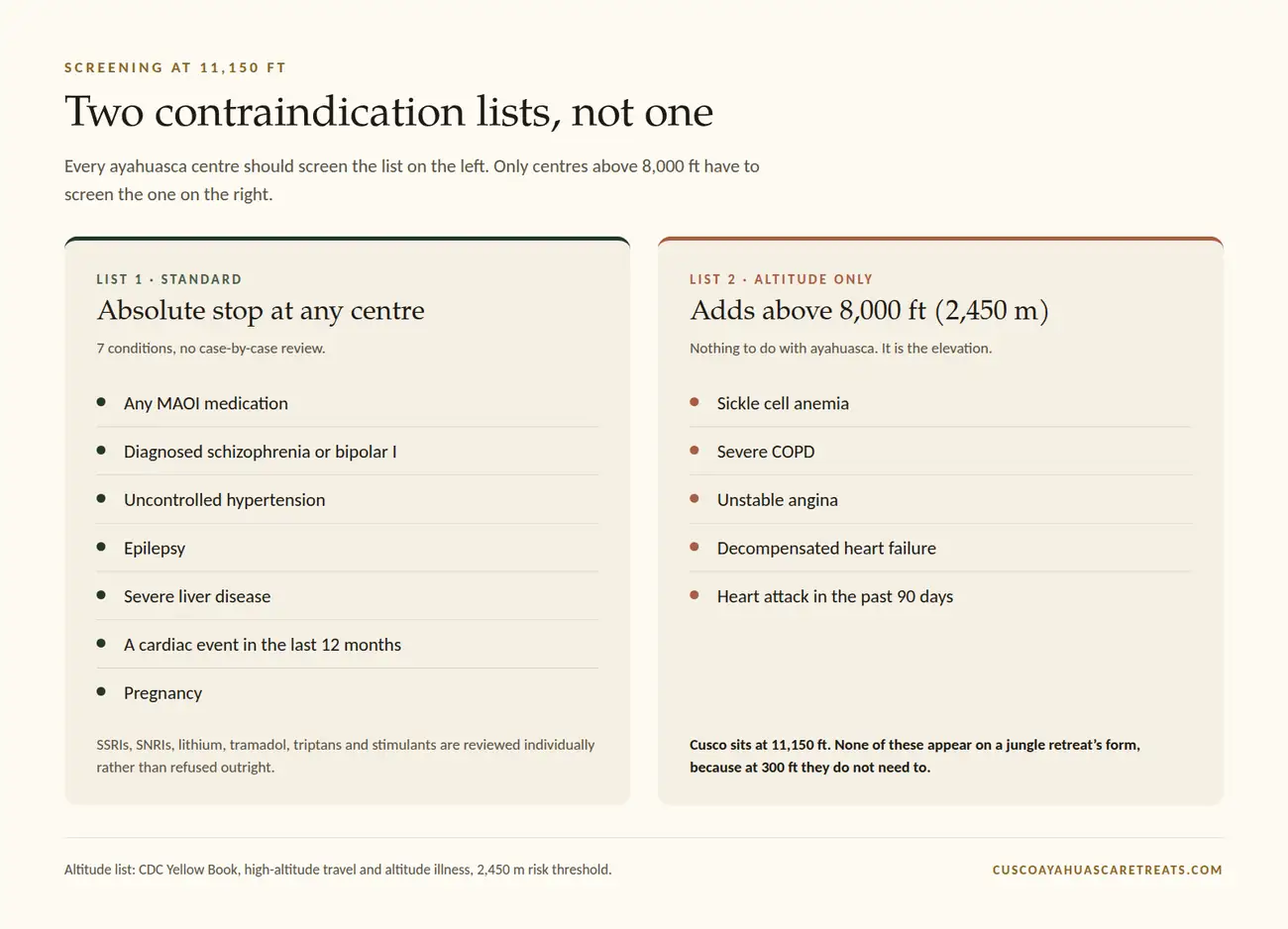
7 conditions rule a person out completely, with no case-by-case review and no exceptions. A second group requires a physician to look at your specific file before anyone says yes.
| Status | Condition or medication |
|---|---|
| Absolute no | Any MAOI medication |
| Absolute no | Diagnosed schizophrenia or bipolar I |
| Absolute no | Uncontrolled hypertension |
| Absolute no | Epilepsy |
| Absolute no | Severe liver disease |
| Absolute no | A cardiac event within the last 12 months |
| Absolute no | Pregnancy |
| Individual physician review | SSRIs and SNRIs |
| Individual physician review | Lithium, tramadol, triptans, stimulants |
The MAOI line is the one people misread. The vine, Banisteriopsis caapi, contains harmala alkaloids that act as reversible MAO inhibitors. That is what makes the DMT in the chacruna leaf work when you drink it. Stack a pharmaceutical MAOI on top and you have 2 sources of the same mechanism. That is why it sits in the absolute column, not the review column.
The psychiatric exclusions are about family history as much as your own. A parent or sibling with schizophrenia or bipolar I matters even if you have never had a symptom. An honest application asks about it. Our 34-question application covers medications, cardiac history, psychiatric family history, expectations, dietary compliance, and what support you have at home. A licensed physician reads every one inside 48 hours, before any payment is taken. About 1 in 5 applications does not proceed, and anyone declined gets the reason in writing plus a referral list.
That rejection rate is the number to ask any center for. A retreat that accepts everyone is not screening.
Your Medication Clean Window Is Not One Number
Almost every retreat site publishes a tidy table with a single washout period for antidepressants. The FDA does not treat them as one class, and neither should you.
The FDA label for Prozac says at least 5 weeks, perhaps longer, should pass after stopping fluoxetine before starting an MAOI, and at least 14 days in the other direction. Fluoxetine gets a longer window than the rest because it clears slowly. Sertraline, escitalopram and paroxetine sit closer to that 14-day mark. One 4-to-6-week band pasted across every antidepressant is over-cautious for some people and wrong for others.
Benzodiazepines are the row that worries me most on other people’s tables. Coming off long-term benzodiazepines too fast carries seizure risk. Publishing a fixed 2-to-3-week clean window with no supervision note attached is bad advice printed in a confident font. Benzodiazepines are handled case by case, by a physician, with your prescriber in the loop, or they are not handled at all.
3 drugs get missed on intake forms more than any others: tramadol, triptans for migraine, and over-the-counter dextromethorphan in cough syrup. All 3 are serotonergic. Tramadol is the most common miss because people file it under painkiller rather than antidepressant.
| Category | Examples | What actually governs the window |
|---|---|---|
| Fluoxetine | Prozac | FDA label: at least 5 weeks, perhaps longer |
| Other SSRIs and SNRIs | Zoloft, Lexapro, Effexor, Cymbalta | Shorter than fluoxetine. Physician sets it against your dose and duration |
| MAOIs | Phenelzine, tranylcypromine, moclobemide | Absolute exclusion. Not a washout question |
| Benzodiazepines | Xanax, Valium, Ativan | No fixed window. Supervised taper only, seizure risk if rushed |
| Serotonergic others | Tramadol, triptans, lithium, St John’s wort, 5-HTP | Individual review. Commonly missed on forms |
| Stimulants | Adderall, Ritalin, Vyvanse, cocaine, MDMA | Individual review, cardiac risk compounds at altitude |
Do not taper anything on your own because a retreat website told you to. Ask your prescriber, then have the retreat’s physician talk to them.
The Second Contraindication List: What Altitude Adds in 2026
Above roughly 8,000 feet, a second set of conditions applies, and it has nothing to do with ayahuasca. The CDC’s Yellow Book puts the altitude-illness risk threshold at 2,450 m (8,000 ft) and lists conditions that should keep a person off high ground regardless of what they plan to do there: sickle cell anemia, severe COPD, unstable angina, decompensated heart failure, and a heart attack within the previous 90 days.
Cusco sits at 11,150 feet. Every one of those conditions applies here and none of them appear on a jungle retreat’s screening page, because at 300 feet above sea level they do not need to.
The overlap is what makes this worth screening twice. Ayahuasca raises blood pressure. Riba and colleagues gave measured doses to 18 volunteers and found diastolic pressure rose 9 mmHg at the higher dose, peaking about 75 minutes in. That study ran in the Journal of Pharmacology and Experimental Therapeutics in 2003. Systolic pressure and heart rate rose too, but not enough to count as significant. Modest on its own. Less modest in a body already 4 days into adapting to thinner air. That is why cardiac history gets weighted harder here than at sea level.
Practically, that means:
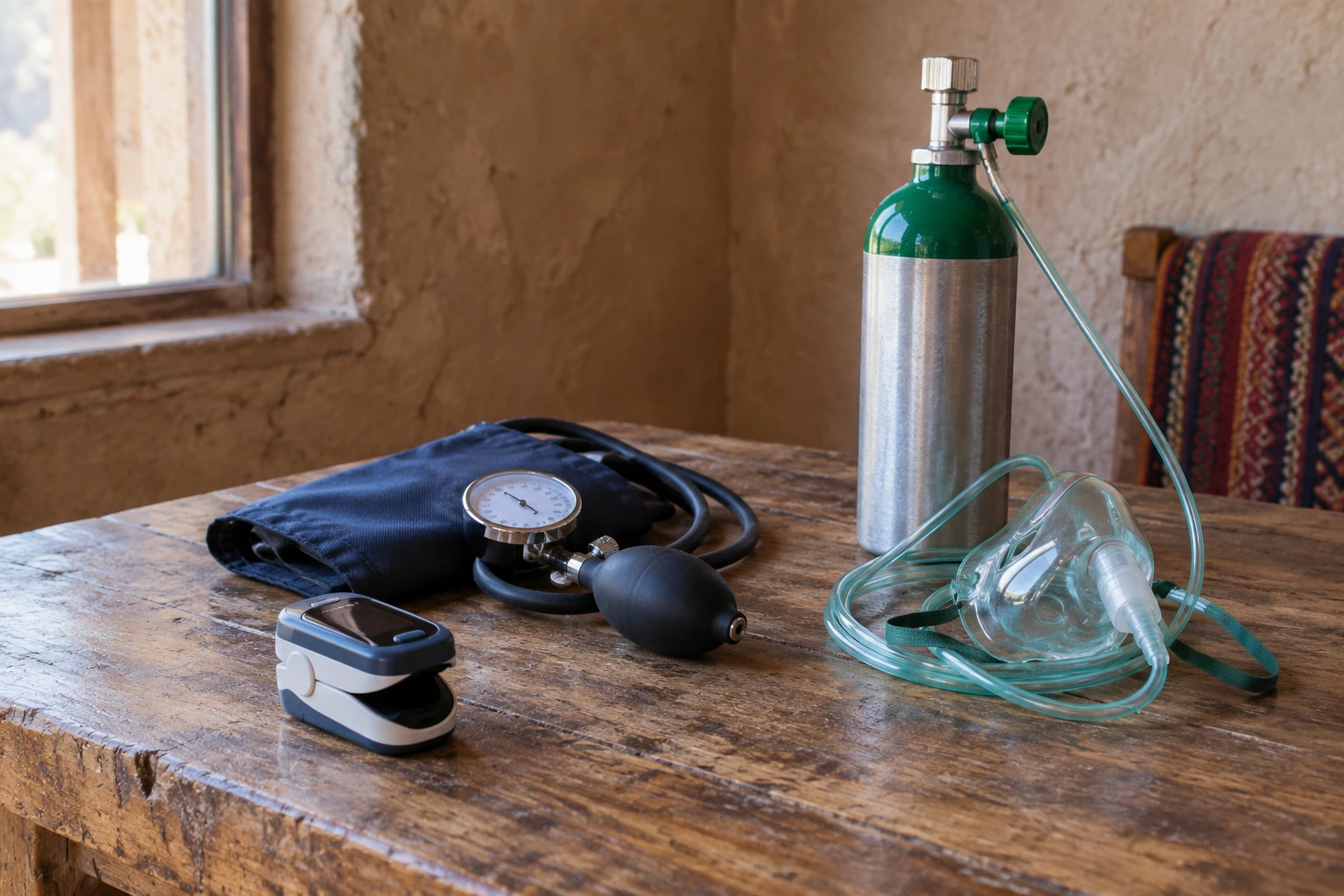
- Blood pressure and oxygen saturation are measured on arrival and again before the first ceremony, not just written down at intake
- 2 full acclimatisation days come before anyone drinks. Nobody drinks on their first or second night in the city
- Supplemental oxygen stays on site
- A licensed physician is awake and present through every ceremony
- The nearest clinic is 12 minutes out, the hospital 20 minutes, and the protocol gets rehearsed with that hospital monthly
Our San Pedro day runs outdoors on Andean terraces rather than in the ceremony room, which is a different altitude exposure again, and it gets cleared separately from ayahuasca.
One genuine advantage of the elevation: there is no malaria risk at 11,150 feet. Antimalarial drugs are a real interaction question at lowland jungle centers. Here the question does not come up.
One caution that does. If your doctor puts you on acetazolamide for the ascent, say so on the application. It is a common altitude prescription, it is not on most retreat medication lists, and it needs to be discussed with the retreat physician rather than assumed harmless.
Does Coca Tea Prevent Altitude Sickness?
No, and the evidence on that is Cusco-specific. A 2021 cohort study of 142 travelers to Cusco, published in the Journal of Travel Medicine by Caravedo and colleagues, found that coca leaf tea was not associated with any reduction in acute mountain sickness. Acetazolamide was, cutting the odds sharply (OR 0.13). Coca tea did nothing measurable.
That study also found 39% of travelers developed acute mountain sickness in their first 48 hours here, with 20% of those cases moderate to severe. Obesity raised the odds more than 14-fold. Female sex raised them more than 4-fold.
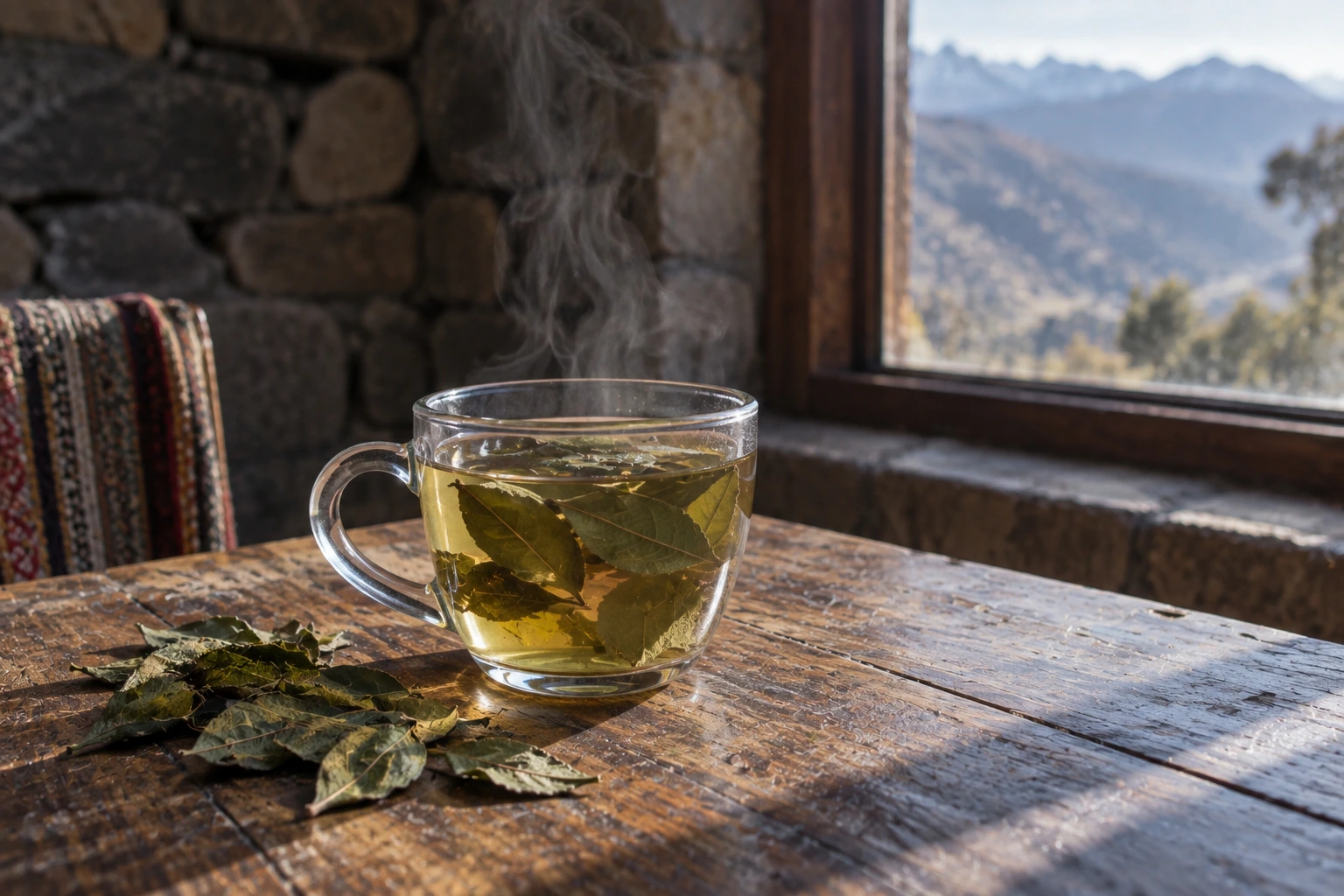
Every hotel, airport and retreat in this city hands you coca tea as the altitude remedy. It is a real part of Andean life and it tastes good. It is not prevention. A retreat that tells you it is has not read the local research. If you want protection, ask a doctor about acetazolamide before you fly, and take more acclimatisation days than you think you need.
Which Side Effects Are Normal and Which Are Not
Purging is normal. Passing out, chest pain, and a fear state that does not resolve are not.
Vomiting hits 62.0% of drinkers according to the Global Ayahuasca Survey, and it is not a sign anything has gone wrong. Neither is diarrhea, shaking, sweating, chills, or being unable to walk to the bathroom unaided during the peak. In a properly staffed room somebody walks you.
What should bring a physician to your mat inside 2 minutes: fainting, chest pain, a heart rate that will not settle, fast shallow breathing that stays that way, or panic that grounding does not touch. At altitude there is one more. Low oxygen saturation looks a lot like panic from the outside. A pulse oximeter settles it in 10 seconds, which is why one should be in the room.
Afterward, feeling raw for a few days is common. The 2025 PLOS Mental Health reanalysis is worth repeating here: extreme fear during ceremony predicted the worst after-effects. That is an argument for preparation and for a room where someone is paying attention to you, not for toughing it out.
What Has Actually Killed People at Ayahuasca Retreats?
Mostly, not ayahuasca. ICEERS reviewed 58 deaths the media attributed to ayahuasca between 2010 and 2022 and found that only 34 confirmed the person had drunk it. No autopsy in any of those cases attributed the death to ayahuasca intoxication.
What did kill people:
- Tobacco and nicotine purges. 4 named deaths came from concentrated tobacco infusions served alongside ayahuasca, including Jennifer Logan, a Canadian whose 2014 death was covered by CBC. This killed more retreat guests than any admixture plant, and it appears on almost no retreat’s warning list
- Scopolamine from Brugmansia, the plant known as toe, added to the brew by practitioners who should not be adding anything
- Water intoxication. 1 death from hyponatremia after drinking far too much water during ceremony
- Cardiac events, including 1 man with undiagnosed Marfan syndrome
Read that list again and notice what it is. It is not a list of ayahuasca risks. It is a list of screening failures, brew adulteration, and unsupervised practice. Which is why the questions below matter more than any pharmacology.
Ask any center: what else do you serve, and what is in the brew? The answer should be the vine and the leaf, nothing else, and no tobacco purge.
How to Tell a Safe Retreat From a Dangerous One
Use questions with a wrong answer. A checklist of green flags is easy to write copy around. A question that a center can fail is harder to fake.
| Ask them | The answer that should end the conversation |
|---|---|
| What percentage of applicants do you turn away? | “We accept everyone” or “we’ve never had to reject anyone” |
| Who reviews my medical form, and what are their credentials? | A facilitator, the shaman, or nobody. It should be a licensed physician |
| Is a doctor physically present and awake during ceremony? | “On call,” “in the village,” or “we have first aid training” |
| Exactly what is in the brew? | Anything beyond the vine and the leaf. Any refusal to say |
| Do you serve tobacco purges? | Yes |
| How far is the nearest hospital, and when did you last rehearse the transfer? | No number, or no rehearsal |
| How many guests per maestro? | More than about 5, or a group over 15 with 1 facilitator |
| What is your policy on staff and guest sexual contact? | Anything other than an immediate, written, zero-tolerance answer |
| What happens if I need to reach you 3 weeks after I get home? | No integration structure, or an email address |
| Do I pay before or after medical clearance? | Before |
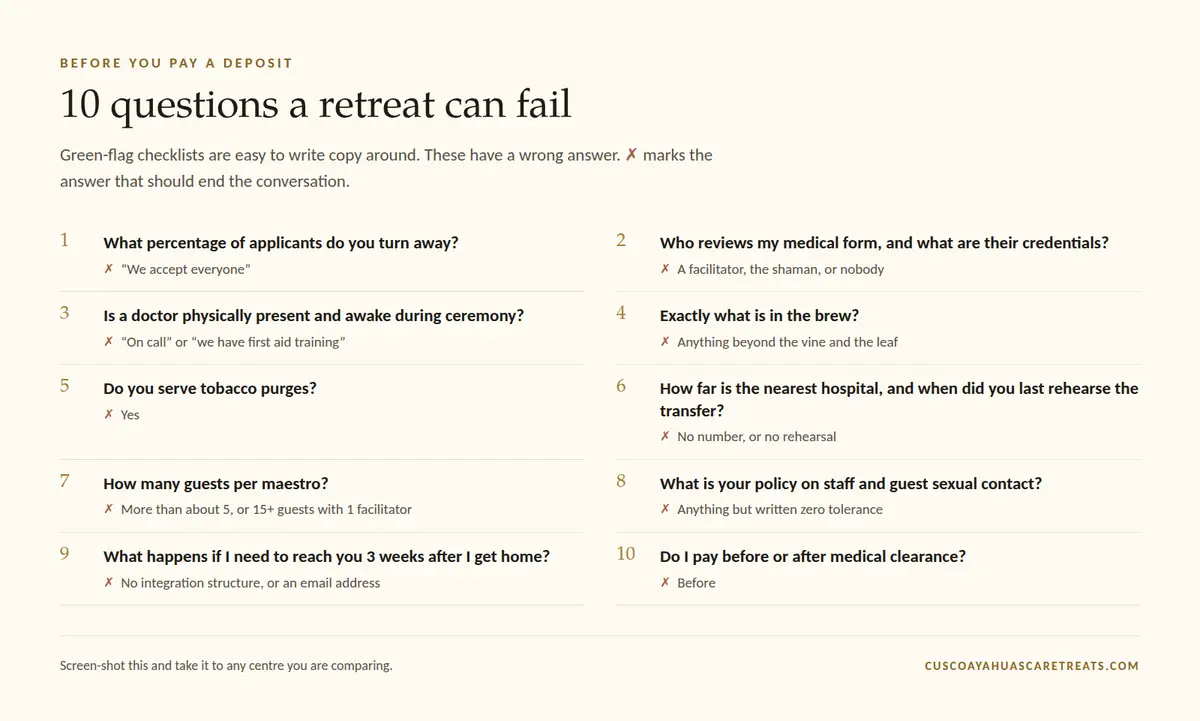
Here is how we answer them, so you have numbers to hold anyone else’s against. About 1 in 5 applications declined. A 34-question form read by Dr. Elena Marquez, an internal medicine physician in Cusco, who also runs intake and stays awake on site through every ceremony. 12 guests maximum, 4 maestros from the Paoyhan and Nueva Betania communities in Ucayali, 1 maestro per 3 guests. Hospital 20 minutes out, transfer protocol rehearsed monthly. No payment taken until the physician clears you. 12 months of integration, 4 calls in the first 3 months then quarterly. The full seven-night week in Cusco is priced at one number with nothing added later.
We also run Kambo and Bufo as separately screened sessions rather than folding them into ayahuasca night. Each needs its own clearance, no 2 medicines are served on the same day, and there is a 24-hour gap minimum. Bufo needs sign-off from both the physician and the integration lead before it happens at all.
One more thing, since ayahuasca safety writing tends to slide into sales. Ayahuasca is not a treatment for any condition, and we make no medical claims about it. If a center tells you the medicine will fix your depression, or that the medicine handles emergencies, walk away. Ask us the hard questions instead.
Frequently Asked Questions
Is Ayahuasca Safe?
Ayahuasca is relatively safe for screened, physically healthy adults in a supervised setting, and physical side effects are close to universal. A survey of 8,216 drinkers published in PLOS Global Public Health found 69.9% had an acute physical adverse effect but only 2.3% needed medical attention. Safety depends far more on screening quality, brew purity and supervision than on the medicine itself.
Who Cannot Drink Ayahuasca at All?
7 conditions are an absolute stop: any MAOI medication, diagnosed schizophrenia or bipolar I, uncontrolled hypertension, epilepsy, severe liver disease, a cardiac event within the past 12 months, and pregnancy. SSRIs, SNRIs, lithium, tramadol, triptans and stimulants are reviewed individually by a physician rather than refused automatically.
How Long Do I Need to Be Off Antidepressants Before Ayahuasca?
It depends on which one, and any retreat quoting a single number for all antidepressants is oversimplifying. The FDA label for Prozac calls for at least 5 weeks, perhaps longer, between stopping fluoxetine and starting an MAOI, while most other SSRIs clear faster. Benzodiazepines have no fixed window at all and need a supervised taper, because stopping them quickly carries seizure risk.
Does Altitude Change Ayahuasca Safety?
Yes, it adds a second contraindication list. The CDC puts the altitude-illness threshold at 2,450 m (8,000 ft) and advises against high-altitude travel for people with sickle cell anemia, severe COPD, unstable angina, decompensated heart failure, or a heart attack in the past 90 days. Cusco sits at 11,150 ft, so those conditions are screened here even though they never appear on a jungle retreat’s form.
Does Coca Tea Prevent Altitude Sickness in Cusco?
No. A 2021 cohort study of 142 travelers to Cusco in the Journal of Travel Medicine found coca leaf tea was not associated with any reduction in acute mountain sickness, while acetazolamide was. That study also found 39% of travelers developed acute mountain sickness within their first 48 hours in the city.
Has Anyone Died From Drinking Ayahuasca?
ICEERS reviewed 58 deaths the media attributed to ayahuasca between 2010 and 2022 and found no autopsy attributed a death to ayahuasca intoxication itself. The documented causes were concentrated tobacco or nicotine purges, which killed 4 named people, scopolamine from Brugmansia added to the brew, water intoxication, and cardiac events. Ask any center what else they serve and exactly what is in the brew.
What Questions Should I Ask an Ayahuasca Retreat Before Booking?
Ask what percentage of applicants they turn away, who reads the medical form and what their credentials are, whether a physician is awake and present during ceremony, exactly what is in the brew, and how far the hospital is. Any center that accepts everyone, refuses to name its brew ingredients, or takes payment before medical clearance has answered the question.
This article is for information only and is not medical advice. Talk to your own doctor about your medications and conditions before applying to any ayahuasca retreat.