What Is Wachuma? 5 San Pedro Claims Checked Against The Record
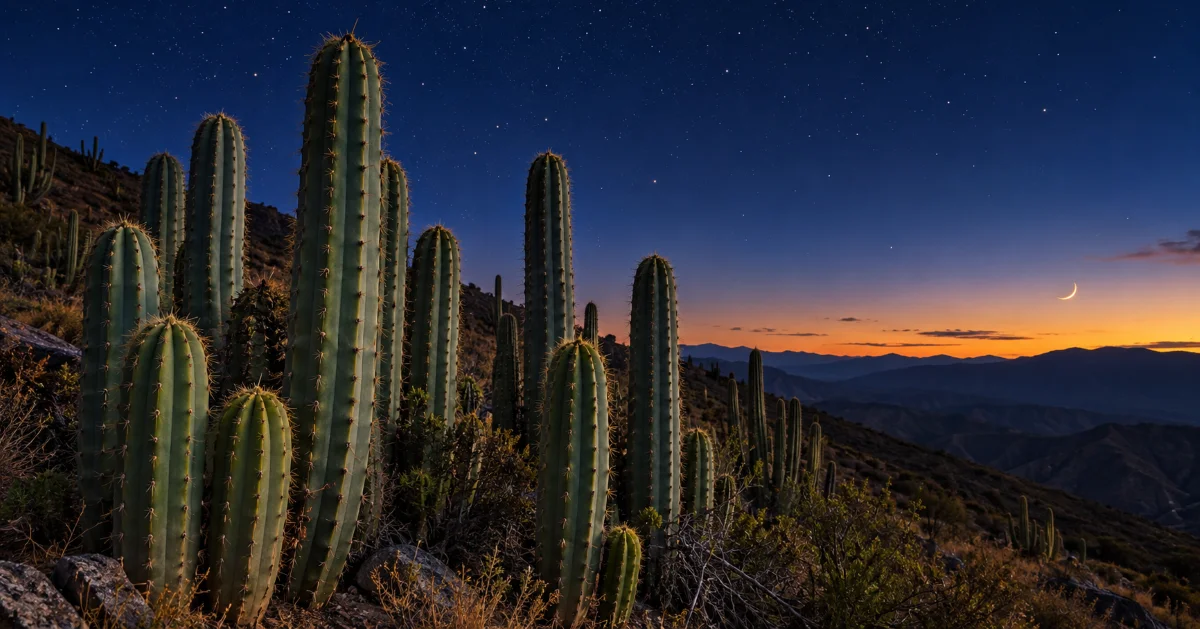
What is wachuma? It’s the San Pedro cactus, a tall Andean cactus whose active compound is mescaline. The trouble starts with what most pages say next. When we checked in September 2026, Google’s AI Overview for this question repeated 5 claims: the word is Quechua, the Spanish named it San Pedro, it’s been used for over 3,000 years, it’s gentle, and it’s traditionally taken by day. The primary sources contradict 2 of those, find no support for a 3rd, trim a 4th and turn the 5th around.
We run a San Pedro day at our centre in Cusco, so we have a stake in getting this right. This page goes back to the records: a 1612 dictionary, Peru’s 2022 heritage decree, the excavation dates at Chavín de Huántar, the fieldwork on northern Peru’s healers, and a 2024 controlled trial of mescaline.
This is education. It isn’t medical or legal advice.
What is wachuma?
Wachuma is San Pedro: a mescaline cactus with an Aymara name and about 2,900 years of carved history.
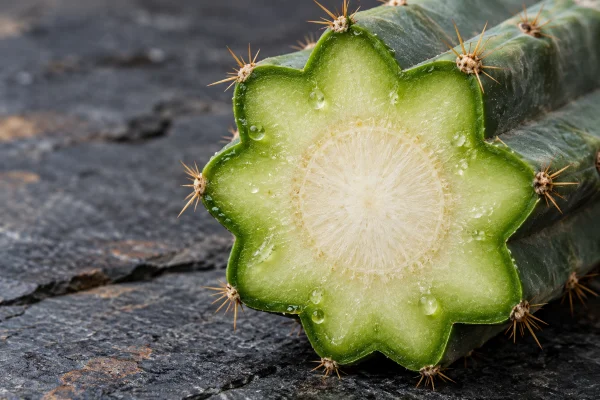
Wachuma, also spelled huachuma or achuma, is the San Pedro cactus, Echinopsis pachanoi, a column cactus native to southern Ecuador and Peru. Its active compound is mescaline. The oldest dictionary entry for the word is Aymara: in 1612, Ludovico Bertonio defined achuma as a large cactus and a drink that makes you lose your judgment for a while.
“San Pedro” is a looser name than most pages admit. Peru’s CITES scientific authority titled its 2013 trade report “El San Pedro o Achuma” and filed the whole Echinopsis genus under it. E. pachanoi is the species most studies mean. Kew’s Plants of the World Online gives its native range as “S. Ecuador to Peru” and records it as introduced in Bolivia, central Chile and Colombia.
5 claims about San Pedro, checked
Each claim sits beside what the record shows and where it shows it.
| The claim | What the record shows | Source |
|---|---|---|
| Wachuma is a Quechua word | The oldest entry is in a 1612 Aymara dictionary. Peru’s Ministry of Culture calls achuma and wachuma “de origen aymara” | Bertonio 1612; Ministry of Culture decree, 2022 |
| The Spanish named it San Pedro | Colonial documents call it achuma or huachuma. The earliest printed “San Pedro” found is from 1922 | Glass-Coffin 2010; Valdizán and Maldonado 1922 |
| It’s been used for over 3,000 years | The best-known carving, at Chavín de Huántar, was built between 800 and 900 BCE, about 2,900 years ago | Rick et al. 2009 |
| San Pedro is gentle | Nausea, vomiting, higher heart rate, blood pressure and temperature. Effects last 6.4 to 14 hours, rising with dose | DEA; Klaiber et al. 2024 |
| It’s traditionally taken by day | The documented northern ceremony ran from about 10 pm to 4 am | Sharon 1972; Ministry of Culture, 2019 |
The oldest record of the word is Aymara
The word’s documented origin is Aymara, the language spoken around Lake Titicaca. Most pages call it Quechua.
Bertonio’s dictionary was printed at Juli, on the shore of Lake Titicaca, in 1612. It defines “Achuma” as “cardo grande,” a large cactus, “y un bebedizo que hace perder el juicio por un rato.” A drink that takes your judgment away for a while.
Peru’s Ministry of Culture says the same in its 2022 heritage decree: achuma, “y su derivación wachuma o guachuma,” is “de origen aymara.” The decree takes the Aymara name as a sign that the plant’s use once covered a much wider area.
The popular meaning “that which opens” turns up on retreat sites. I couldn’t find it in any dictionary or scholarly source. The only documented meaning is Bertonio’s, and it’s blunter.
Why is it called San Pedro?
No record says who named it or why. The usual story, that Saint Peter holds the keys to heaven and the cactus opens the gate, is an explanation that came later.
Colonial documents call the plant achuma or huachuma, anthropologist Bonnie Glass-Coffin notes. The earliest printed “San Pedro” I found is in Valdizán and Maldonado’s 1922 survey of Peruvian folk medicine. Douglas Sharon, writing in 1972, credited John Gillin’s 1945 fieldwork as the first to record the cactus’s role. On the name, Sharon wrote: “How and why it came to be called ‘Saint Peter’ was not stated.”
The name may be older than 1922. Nobody has shown it, and I found no colonial record that uses it.
The Chavín carving is about 2,900 years old
The famous image of a figure holding San Pedro is real. It’s younger than the 3,000 years usually attached to it.
At Chavín de Huántar, in the Áncash highlands north of Lima, carved stone panels ring the Circular Plaza of the Old Temple. One shows “a feline-human figure holding a staff of San Pedro cactus,” in the words of the Stanford-led project that excavated the site. That team dated the plaza’s construction to between 800 and 900 BCE.
Older claims lean on thinner evidence. Offering figurines at Garagay, near Lima, date to 1200 to 1000 BCE, and one reading has them holding cactus spines as staffs. Pollen from a related cactus turns up in Guitarrero Cave’s earliest layers. It shows the plant grew there. It doesn’t show anyone drank it.
A last correction while we’re here. Huachuma isn’t the oldest plant medicine on record in the Andes. Coca chewing is documented “by at least 8000 cal BP” in northern Peru’s Nanchoc Valley (Dillehay et al. 2010).
The tradition Peru protects is northern
The huachuma tradition Peru has written into law belongs to the curanderos of northern Peru.
The 2022 decree covers “las prácticas del curanderismo en el norte del Perú” and names 7 regions: Lambayeque, La Libertad, Piura, Tumbes, Cajamarca, Amazonas and Áncash. Cusco isn’t among them. Sharon’s fieldwork centred on the lagoons called Las Huaringas, “above the town of Huancabamba” near the Ecuador border. It also took in Salas, “reputed to be the capital of north coastal healers.” In 2019 Peru’s Ministry of Culture put Las Huaringas on the country’s UNESCO World Heritage Tentative List, describing the healing practice there.
The decree also draws a line. It sets traditional use apart from “toxicomanía, uso recreativo, o de turismo místico”: addiction, recreational use or mystical tourism. A Cusco retreat that sells a San Pedro day to visitors, ours included, isn’t what the decree protects. We’d rather say so than borrow its authority.
The documented ceremony ran at night
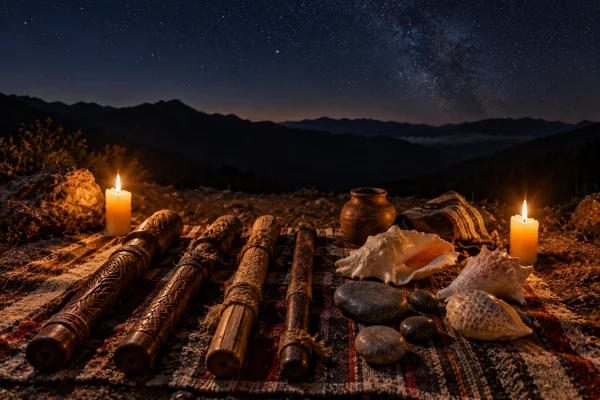
Every documented account of the northern healing ceremony I found runs through the night. The daytime ceremony is how Cusco serves San Pedro today.
Sharon timed the sessions he recorded: “The ceremonial part lasts generally from about 10 P.M. until midnight; diagnosis and / or treatment lasts from midnight until about 4 A.M.” Describing Las Huaringas to UNESCO, Peru’s Ministry of Culture calls the mesada the nocturnal rite, in which the healer makes a diagnosis by “visualizing” the cause. Glass-Coffin quotes a 1730s Inquisition case from Cajamarca in which a healer worked “from seven o’clock at night until the break of dawn.”
The line you’ll read on most pages, that San Pedro is “traditionally” a daytime medicine, has no source I could find. Even the strongest page ranking for huachuma, a September 2026 explainer in The Conversation, says “huachuma ceremonies happen in daylight.”
Ours runs in daylight too. The cup is poured at 7:00 am with the sun still on the ridge, and the day lasts 12 to 13 hours outdoors. You should know the format you’re booking has a history, and that the northern healers kept a different clock.
No 2 cups carry the same dose
A cup of San Pedro has no standard strength, because the cactus doesn’t have one.
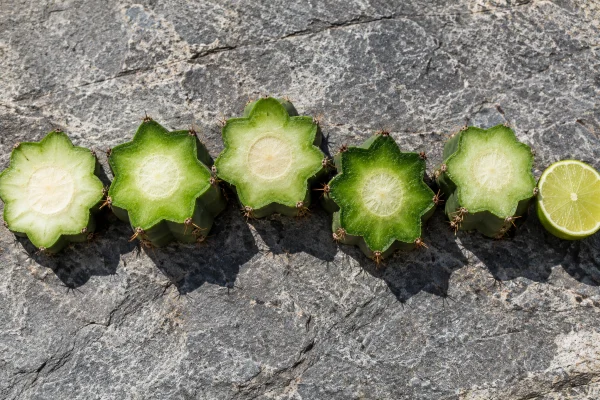
In 2010, researchers measured mescaline in 14 kinds of San Pedro cactus and found 0.053% to 4.7% of dry weight, a spread of 2 orders of magnitude. Within E. pachanoi alone, 5 samples ran from 0.54% to 4.7%, nearly 9 times apart. The strongest came from a supplier to “traditional Peruvian shamans’ markets.” They tested the green outer layer of the stem. A 2025 study found 2 to 4 times more mescaline in that layer than in the pale core.
So a recipe can’t set the dose. Our huachumero sets it “from your body weight and what he has seen of you that week, not by what you ask for.” He cuts the cactus himself from stands within about 40 minutes of the house, and it’s sliced and boiled here in an open pot for around 12 hours the day before. Ask which cut your cup came from and you’ll get a place and a date. The cup is thick, green and bitter, and you drink it in one go with lime after.
Is San Pedro gentle?
No. It lasts most of a day and raises heart rate and blood pressure. In a controlled trial, the top dose made 7 of 16 people vomit.
The DEA’s fact sheet on peyote and mescaline lists “intense nausea, vomiting, dilation of the pupils, increased heart rate, increased blood pressure, a rise in body temperature that causes heavy perspiration, headaches, muscle weakness, and impaired motor coordination.” In a 2024 double-blind trial published in Translational Psychiatry, 16 healthy volunteers took mescaline at 4 doses. Effects lasted 6.4 hours on average at 100 mg and 14 hours at 800 mg, and blood pressure, heart rate and body temperature rose.
Real-world use runs long too. In a 2022 survey of 452 mescaline users, 218 named San Pedro as their most memorable experience, and 60% of those said it lasted 11 hours or more.
On our day, roughly half of guests purge once, usually in the first 2 hours, and then it’s over. Hours 4 to 7 are the peak.
“Gentle” usually means fewer visions and less of the sense of being taken apart. That describes how some people feel. It tells you nothing about your blood pressure at hour 9.
Who we turn away from the San Pedro day
A physician reads every application before a place is offered, and roughly 4 in 5 applicants who ask for San Pedro are cleared.
Our absolute stops are MAOI medication of any kind, diagnosed schizophrenia or bipolar I, uncontrolled hypertension, a cardiac event within 12 months, epilepsy or severe liver disease, pregnancy or breastfeeding, and being unable to walk unassisted for an hour. SSRIs, SNRIs, lithium, tramadol, triptans, stimulants, beta blockers and blood pressure medication are reviewed one by one. SSRIs and SNRIs usually mean a supervised taper planned with your own prescriber.
The research behind those rules is thin. A 2024 systematic review of psychedelic drug interactions found 52 studies, 4 of them on mescaline, and none on mescaline with SSRIs, MAOIs or lithium. With lithium, 47% of 62 online reports of psychedelic use described seizures, a signal that covers psychedelics as a class. Missing data is a reason for caution.
A physician walks up with the group and stays all day, with oxygen, blood pressure monitoring and a defibrillator at the terrace. Read how our screening works and who reads your file.
Is wachuma legal in Peru in 2026?
Peru protects the northern healing knowledge as heritage, lists mescaline as a prohibited substance, and names no cactus in its drug list. That’s a summary of the documents. It isn’t legal advice.
The 2022 decree is a heritage declaration. It contains no drug-law language and it legalizes nothing. Peru’s controlled-substance list under Supreme Decree 023-2001-SA puts mescaline on List IB, where production, trade and use are prohibited, and it names no cactus. Echinopsis exports need CITES permits, because the genus is on Appendix II.
In the US, mescaline is Schedule I. San Pedro isn’t named in federal law, but the rule covers “any material… which contains any quantity of” mescaline.
Pages that tell you San Pedro is “legal in Peru when used in traditional, cultural, and ceremonial contexts” are describing a law I couldn’t find.
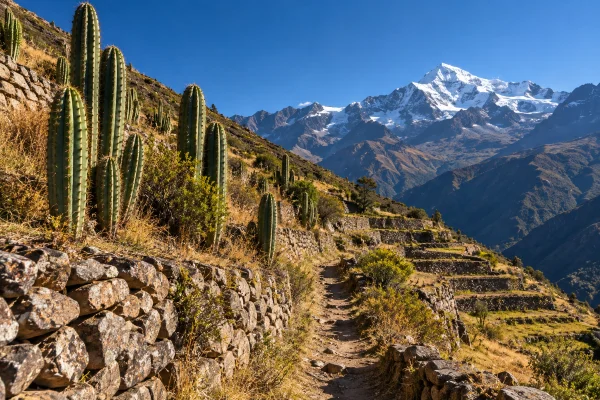
How our San Pedro day runs
The San Pedro day falls mid-week, never in the first 2 days, and the group spends 12 to 13 hours outdoors with our huachumero.
It sits on the long rest day, at least 24 hours from any ayahuasca ceremony either side. The cup comes at 7:00 am. A second, smaller cup is sometimes offered around 10:00 am, and declining it is a complete sentence. The group walks the terraces and trail through the peak, then walks back down as the intensity draws off over 2 or 3 hours. A fire is lit in the courtyard and the kitchen brings simple dieta food.
The San Pedro day comes inside the 7-night week, which is $5,800, and it isn’t sold on its own. If you’re weighing the 2 medicines, we’ve set their taste side by side.
Search “what is wachuma” and you’ll get a cactus, a teacher, a gentle grandfather and 3,000 years. The record gives you an Aymara word, a mescaline drink that runs most of a day, a northern night ceremony and about 2,900 years of carving. If you want the Cusco version, with a physician on the terrace, send us your application and the physician reads your file before anything else happens.
Frequently asked questions about wachuma
What is wachuma?
Wachuma is the San Pedro cactus, Echinopsis pachanoi, an Andean cactus whose active compound is mescaline. The oldest record of the word is in a 1612 Aymara dictionary, which defines achuma as a large cactus and a drink that takes your judgment away for a while.
Is wachuma the same as San Pedro and huachuma?
Yes. Wachuma, huachuma and achuma are spellings of the same Andean name, and San Pedro is the Spanish name, with the earliest printed use found so far dating to 1922. “San Pedro” can also cover related Echinopsis cacti, and E. pachanoi is the species most studies mean.
Is wachuma a psychedelic?
Yes. Its active compound, mescaline, is a psychedelic listed in Schedule I of the UN’s 1971 Convention on Psychotropic Substances. In a 2024 controlled trial, its effects lasted 6.4 to 14 hours depending on dose.
Are San Pedro ceremonies held during the day or at night?
The documented northern healing ceremony ran at night, from about 10 pm to 4 am in Douglas Sharon’s 1972 record, and Peru’s Ministry of Culture calls the mesada “the nocturnal rite.” Cusco ceremonies, ours included, run by day. Our cup is poured at 7:00 am and the day lasts 12 to 13 hours.
How long does San Pedro last?
Most of a day. In a 2024 trial, mescaline’s effects averaged 6.4 hours at 100 mg and 14 hours at 800 mg. In a 2022 survey, 60% of 218 people whose most memorable mescaline experience was San Pedro said it lasted 11 hours or more.
Is San Pedro legal in Peru?
Peru declared the traditional knowledge of San Pedro in northern curanderismo national cultural heritage in November 2022, and that decree legalizes nothing. Peru’s controlled list prohibits mescaline and names no cactus. This summarizes the documents and isn’t legal advice.
Who shouldn’t take San Pedro?
At our centre, MAOI medication, schizophrenia or bipolar I, uncontrolled hypertension, a cardiac event within 12 months, epilepsy, severe liver disease, pregnancy and breastfeeding are absolute stops. The physician reviews SSRIs, SNRIs, lithium and blood pressure drugs one by one. Roughly 4 in 5 applicants who ask for San Pedro are cleared.